Can You Sell an iCloud Locked iPhone? Seller's Guide
August 11, 2026
Yes, you can sell an iCloud locked iPhone in the United States. Selling a device you legitimately own is legal even when Activation Lock is still active. That said, buyer interest is narrower and offers will be lower than for a clean, unlocked device. Here are your three immediate next steps:
- Contact the previous owner and ask them to sign out of iCloud or remove the device at icloud.com/find. This is the fastest path to a full-value sale.
- Contact Apple Support with proof of purchase (original retail receipt showing the serial number or IMEI) and request an Activation Lock removal.
- Sell it as “iCloud locked / parts only” to a buyback service, recycler, or repair shop if neither of the above is possible. Buyback stores and recyclers commonly accept locked devices, though at a reduced price.
Key Takeaways
Selling an iCloud locked iPhone is legal in the U.S. when you own the device legitimately, but realistic value depends on model, condition, and whether the lock can be removed before sale.
| Point | Details |
|---|---|
| Selling is legal | You can sell a legitimately owned iCloud locked iPhone; offers are lower than for unlocked devices. |
| Two removal routes | Contact the previous owner via icloud.com/find, or submit an Apple Support request with original proof of purchase. |
| Marketplace receipts often fail | eBay and PayPal receipts typically do not meet Apple’s proof standard; original retail receipts with serial/IMEI do. |
| Avoid bypass scams | Third-party unlock services are almost always fraudulent or temporary; the server-side lock remains active. |
| Buybackbear accepts locked iPhones | Buybackbear provides instant quotes, NIST 800-88 certified data wipes, and responsible recycling for devices that cannot be resold. |
This article is general information, not a substitute for advice from a qualified lawyer. Consult a qualified legal professional about your own circumstances before acting on anything here.
Table of Contents
- What is Activation Lock and why does it block resale?
- How do you check if your iPhone is Activation locked?
- Is it legal to sell an iCloud locked iPhone?
- How can you legitimately remove Activation Lock before selling?
- Where can you sell an iCloud locked iPhone?
- How much is an iCloud locked iPhone worth?
- How to prepare an iCloud locked iPhone for sale
- Why “iCloud unlock” services are almost always scams
- Activation Lock, repairability, and the environmental cost
- A note on how Buybackbear handles locked devices
- Buybackbear makes selling a locked iPhone straightforward
- Sources
- FAQ
What is Activation Lock and why does it block resale?
Activation Lock is Apple’s anti-theft feature that switches on automatically when you enable Find My on an iPhone. It ties the device to the owner’s Apple Account on Apple’s activation servers, not just locally on the device. That distinction matters: wiping the phone does not remove the lock. A factory reset leaves the device asking for the original Apple ID and password on startup.
Here is what a locked iPhone cannot do until the lock is cleared:
- Complete setup, the device is stuck at the Activation Lock screen after a reset.
- Be reactivated by a new owner, carrier activation requires passing Apple’s server-side check.
- Qualify for AppleCare service or carrier trade-ins, most programs reject locked devices outright.
- Be used for parts in some cases. Apple has extended Activation Lock to certain components. Previously used displays, batteries, and cameras can carry their own lock, making them ineligible for warranty service or trade-in until removed.
The server-side enforcement makes third-party “unlock” services largely ineffective, a point covered in the warnings section below.
How do you check if your iPhone is Activation locked?
Before listing the device anywhere, confirm its exact status. Here is how:
- Power it on and watch the startup screen. A message reading “iPhone Locked to Owner” or a prompt for an Apple ID and password at setup means Activation Lock is active.
- Go to Settings > General > Transfer or Reset iPhone on a device you still have access to. If Find My is on and an Apple ID is signed in, the lock will engage after any erase.
- Ask the original owner to check icloud.com/find. They can see the device listed under their account and remove it from there without touching the phone.
- Run an IMEI or serial check through a reputable checker. This can reveal whether the device is also carrier blacklisted, which is a separate issue from Activation Lock but equally important for buyers.
Pro Tip: Never post your IMEI or serial number publicly in a listing or forum. Share it privately with verified buyers only. Screenshot the Activation Lock screen before you erase or ship the device, that documentation can support an Apple Support request later.
Is it legal to sell an iCloud locked iPhone?
Selling a legitimately owned iCloud locked iPhone is legal in most U.S. cases. The lock itself does not make the transaction unlawful. What makes a sale illegal or risky is the device’s ownership history, not its lock status.
You must not sell the device if:
- It was reported lost or stolen by the original owner. Carriers and law enforcement maintain blacklists (GSMA Device Check, CTIA’s Stolen Phone Checker) that flag these devices by IMEI.
- You cannot demonstrate legitimate ownership. If you bought it secondhand and have no receipt, no box, and no way to contact the seller, that is a red flag for buyers and potentially for law enforcement.
- It is carrier blacklisted. A blacklisted device is barred from most U.S. networks regardless of whether Activation Lock is removed.
What buyers and law enforcement may request:
- IMEI or serial number for a blacklist check
- Original proof of purchase (receipt, carrier contract, or insurance claim)
- A police report if the device was lost or stolen and later recovered
Buyers who skip these checks take on real liability. Reputable buyback services run IMEI checks as part of their inspection process, which protects both parties.
How can you legitimately remove Activation Lock before selling?
Two routes exist. Neither involves a third-party tool.
- Get the previous owner to remove it. This is the only guaranteed path. The original owner signs into icloud.com/find, selects the device, and clicks “Remove from Account.” The lock clears within minutes. If you bought the phone used and the seller is reachable, this is always worth attempting first.
- Submit an Apple Support Activation Lock removal request. Apple can remove Activation Lock remotely if you provide valid proof of purchase and the device is not reported stolen or lost. Apple’s standard for acceptable documentation is strict.
What Apple accepts:
- An original retail receipt from Apple or an authorized reseller that shows the device’s serial number or IMEI
- In some cases, carrier records from the original sale that tie the IMEI to a named account
What Apple typically rejects:
- eBay, PayPal, Facebook Marketplace, or Craigslist receipts that lack a matching serial number or IMEI
- Screenshots of a purchase conversation or bank statements alone
- Invoices that appear altered or do not match Apple’s purchase records
Many marketplace receipts simply do not meet Apple’s proof standard, which is why sellers who bought a locked device secondhand often find themselves stuck. If Apple’s support route fails and the previous owner is unreachable, selling as “locked / parts only” is the realistic path forward.
Where can you sell an iCloud locked iPhone?
Several buyer types accept locked devices, each with different expectations and payout levels.
- Online buyback services (such as Buybackbear): Accept many locked iPhones, run an IMEI check on receipt, inspect condition, and pay cash. They typically accept devices that are Activation locked but not carrier blacklisted, though some recyclers will take blacklisted units at a lower rate. The process is straightforward: get a quote, ship free, get paid after inspection.
- Recyclers and e-waste programs: Accept locked and blacklisted devices for responsible disposal or parts harvesting. Payouts are lower than buyback services, but they handle devices that have no resale path.
- Repair shops and parts buyers: Local repair shops often buy locked iPhones for screen assemblies, cameras, and other components. Prices vary widely. A shop that repairs a lot of that specific model will pay more than one that rarely sees it.
- Private marketplace listings (parts only): Platforms like eBay allow “for parts / not working” listings. You can reach buyers who know exactly what they are getting. Be explicit in the title and description: “iCloud locked, Activation Lock active, for parts only.” Expect lower offers and more questions than a clean listing.
The table below summarizes what each channel typically accepts and what to expect:
Pro Tip: Get at least three quotes before committing. A locked iPhone 15 Pro in good physical condition will fetch meaningfully more than a cracked iPhone 12 with a dead battery, even with the same lock status. Use Buybackbear’s free valuation tools to benchmark offers.
How much is an iCloud locked iPhone worth?
Activation Lock cuts resale value, but it does not eliminate it. The actual offer depends on several factors working together.
Factors that raise value:
- Recent, popular model (newer iPhone models tend to have stronger parts demand)
- Good physical condition, no cracked screen, functional Face ID
- High storage capacity
- Not carrier blacklisted
Factors that lower value:
- Carrier blacklisting (separate from Activation Lock, but often present together)
- Cracked screen or damaged Face ID sensor
- Swollen or dead battery
- Older model with limited parts demand
- Water damage indicators triggered
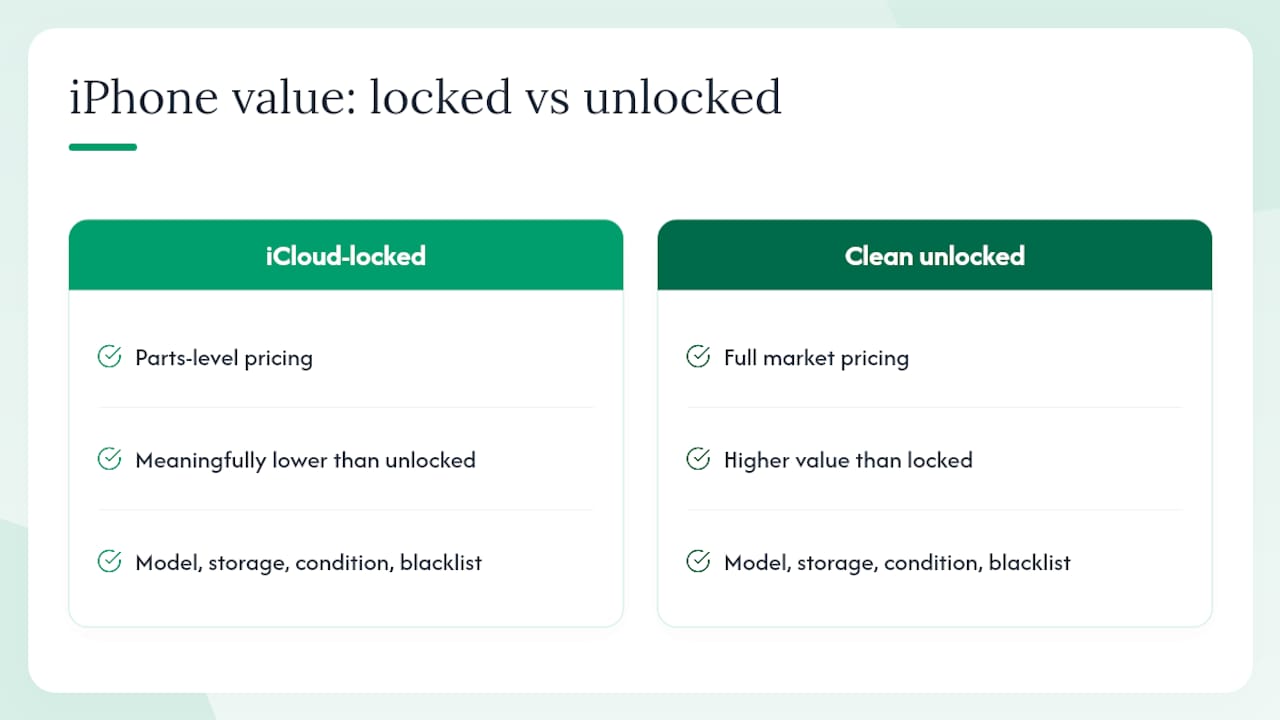
Activation Lock reduces tradable value because it limits what a buyer can do with the device. A locked iPhone cannot be resold as a working unit, so buyers price it as parts or as a refurbishing project that requires owner cooperation. Typical offers for locked devices at buyback services are meaningfully lower than those for unlocked units, depending on the model and condition.
To get the best offer, photograph the device thoroughly, record the serial number and IMEI privately, and share that information with buyers during the quote process. Comparing at least three quotes is worth the extra ten minutes.
How to prepare an iCloud locked iPhone for sale
A little preparation prevents disputes, returns, and wasted time on both sides.
Before listing:
- Photograph every surface of the device, including the screen, back, sides, and any damage.
- Record the serial number (Settings > General > About, or the SIM tray on some models) and IMEI. Keep these private until you are in a verified transaction.
- Document any known repairs, replacements, or damage history.
- Remove any personal accounts you still have access to. If you are the original owner and simply forgot your Apple ID password, Apple’s account recovery process may be worth attempting before selling.
What to disclose in every listing:
- “iCloud / Activation locked” stated clearly in the title, not buried in the description
- “For parts / not for use” if the device cannot be set up
- Physical condition and any known issues (cracked glass, battery health, water damage)
Transaction safety:
- Prefer buyers with a formal inspection policy. Buyback services that inspect on receipt and confirm the offer before payment protect you from post-sale disputes.
- For private sales, never ship before payment is confirmed. Use a tracked, insured shipping method.
- For local cash sales, meet in a public place and do not hand over the device until payment clears.
Why “iCloud unlock” services are almost always scams
The market for third-party Activation Lock removal is full of fraud. Here is what to watch for.
Red flags for scam services:
- Claim to unlock any iPhone remotely using only the IMEI or serial number, with no physical access
- Require upfront payment before any inspection or demo
- Offer “guaranteed” permanent unlocks with no conditions
- Have no verifiable business address, no reviews on independent platforms, or reviews that all appeared within a short window
Why technical bypasses fail in practice:
Local bypass tools are device-specific, iOS-version-specific, and do not remove the server-side Activation Lock. They may allow limited access to the device but typically disable cellular service in the process. A factory reset or iOS update reapplies the lock. The device is not actually unlocked, it is temporarily patched in a way that breaks other functions.
Beyond the technical limits, many bypass tools violate Apple’s terms of service and some involve software that can compromise the device’s data security. If you hand a locked iPhone to a service that claims to bypass it, you may get back a device with disabled features, a voided warranty, and no actual change to the server-side lock status.
The only legitimate removal routes are the previous owner and Apple Support. Everything else is a workaround with a shelf life.
Activation Lock, repairability, and the environmental cost
There is a broader issue here that the repair and recycling industry has been pushing back on for years. When Apple extends Activation Lock to individual parts like displays and batteries, it creates a situation where functional components cannot be reused in another device without the original owner’s credentials. A working screen pulled from a water-damaged iPhone becomes e-waste if the lock cannot be cleared.
Repair professionals and recyclers have called for clearer proof-of-ownership systems that would allow legitimate refurbishers to unlock and reuse parts from devices whose owners are no longer reachable. The current system protects against theft effectively, but it also pushes repairable and reusable hardware toward the scrap pile faster than necessary.
The practical takeaway for sellers: when your device genuinely cannot be unlocked, choosing a certified buyer who recycles responsibly is the better outcome than letting it sit in a drawer or end up in a landfill. Buybackbear recycles devices that cannot be resold, keeping components out of the waste stream.
A note on how Buybackbear handles locked devices
At Buybackbear, locked iPhones go through the same inspection and data security process as any other device. Every phone receives a NIST 800-88 compliant data wipe with a free Certificate of Data Erasure, so sellers have documented proof that their personal data is gone. Devices that cannot be resold are recycled responsibly rather than discarded.
The process is built for sellers who want certainty: an instant online quote, free prepaid shipping, a thorough inspection on receipt, and same-day cash payment by PayPal, Venmo, debit card, or bank transfer. Businesses with multiple locked devices can use Buybackbear’s bulk buyback program for fleet-level disposal with the same certified wipe standard.
Buybackbear makes selling a locked iPhone straightforward
Selling a locked iPhone through a private listing takes time, invites lowball offers, and puts you in the position of explaining Activation Lock to every buyer who asks. Buybackbear cuts through that.
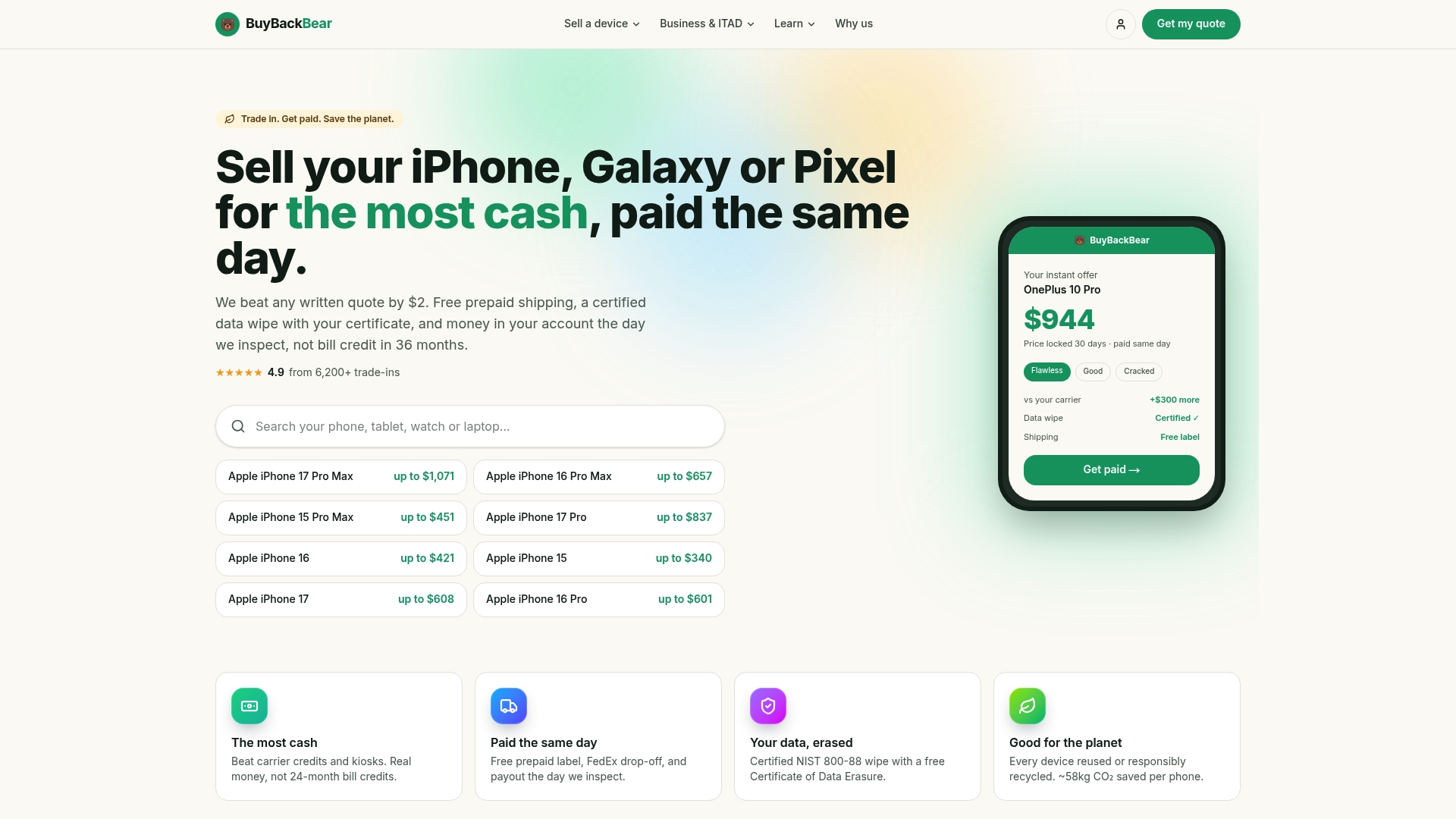
Get an instant quote for your Apple device in under a minute. Ship free with a prepaid label. Buybackbear inspects the device on receipt, confirms the offer, and pays cash the same day, no bill credit, no waiting, no contract. Every device gets a NIST 800-88 certified data wipe with a Certificate of Data Erasure. Devices that cannot be resold are recycled responsibly. For businesses or schools disposing of multiple locked iPhones, the bulk buyback program handles fleet-level disposal with the same certified process. Start your quote now and get paid today.
Sources
- How to remove Activation Lock - Apple Support
- Sell iCloud Locked iPhone’s ($) Activation Locked Trade-in
- Apple expands Activation Locks to phone parts (Resource Recycling)
- How to Remove iCloud Activation Lock from a Used iPhone | MacObserver
FAQ
How much is an iCloud locked iPhone worth?
Value depends on model, storage, physical condition, and whether the device is also carrier blacklisted. A locked iPhone in good physical condition typically fetches parts-level pricing, which is meaningfully lower than a clean unlocked device of the same model.
Can an iCloud locked iPhone be unlocked?
Yes, through two legitimate routes: the original owner removes the device via icloud.com/find, or you submit an Apple Support Activation Lock removal request with an original retail receipt showing the serial number or IMEI. Third-party bypass tools do not remove the server-side lock.
Does anyone buy iCloud locked iPhones?
Yes. Buyback services, recyclers, and repair shops regularly accept iCloud locked devices for parts or refurbishing. Buybackbear accepts locked iPhones, runs an inspection on receipt, and pays cash the same day.
Can I sell a locked iPhone to Apple?
Apple’s trade-in program generally requires a device that can be activated and verified. If Activation Lock is active and you cannot remove it, Apple’s trade-in route is typically not available. Your best option is a buyback service or recycler that accepts locked devices.
Recommended
Ready to sell?
Get an instant quote, free prepaid shipping, and fast cash that beats carrier trade-in credit.
Selling your device here, at a glance
Get my instant quote →- Instant quote in about 30 seconds, price locked while you decide
- Cash by PayPal, Zelle, Venmo or check after inspection, no fees
- Free prepaid label both ways, free return shipping if you decline
- We beat any competitor's written quote by $2
- Cracked screen, broken or won't power on? Still worth real money
- Certified NIST 800-88 data wipe with an emailed certificate
- Trade-in value paid in cash, not a 24-36 month carrier bill credit
- Every model priced: unlocked or carrier-locked, any storage size