U.S. Customer Satisfaction Guarantees: 30–90 Day Templates That Comply
September 17, 2026
A customer satisfaction guarantee is a seller’s promise to refund, replace, or credit a purchase if the buyer isn’t happy with it. Under 16 C.F.R. $239.3, the FTC treats phrases like “satisfaction guaranteed” as an enforceable commitment: you must be ready to refund the full purchase price on request, and any conditions attached to that promise need to be disclosed clearly and prominently. This guide covers the main guarantee types, the legal checklist, ready-to-use copy templates, and how to measure whether the guarantee actually pays for itself.
TL;DR:
- Guarantees must clearly disclose any limitations in the same visual space as the main promise to meet FTC compliance standards.
- Performance-based guarantees, such as “lasts 15 years,” can unintentionally turn into warranties, triggering additional legal obligations.
- Running small pilots helps determine if the guarantee increases lifetime value enough to justify the associated costs and potential refund risks.
- Refunds typically cost more in logistics and support than the refunded amount, so feasible reverse logistics are crucial before launching a guarantee.
- The best guarantee templates clearly state the promise, conditions, and process upfront, with full terms linked on dedicated policy pages.
Table of Contents
- Common Types of Customer Satisfaction Guarantees
- Satisfaction Guarantee vs. Warranty vs. Money-Back Guarantee: What’s the Difference?
- What Federal Law Requires: FTC Rules on Satisfaction Guarantees
- How to Write and Display a Compliant Satisfaction Guarantee
- What a Satisfaction Guarantee Actually Costs a Business
- Guarantee Templates You Can Adapt Today
- How to Measure If Your Guarantee Is Working
- When a Guarantee Helps and When It Backfires
- How Buybackbear Handles the Payout Promise It Makes
- Sources
- FAQ
Common Types of Customer Satisfaction Guarantees
Not every guarantee fits every product. A software subscription and a mattress company solve very different trust problems, and the guarantee structure should match the purchase risk, not just industry habit.
Money-back guarantees are the default for a reason: they’re the easiest for customers to understand. A “return it within 30 days for a full refund” promise converts well on lower-priced, lower-risk items, and the 30 to 90-day window has become something close to a customer expectation rather than a bonus.
Free trials work best when the customer needs to physically experience the product before trusting it. Mattress companies popularized the 100-night trial for exactly this reason: you cannot judge a mattress from a store visit, so the guarantee removes the barrier that would otherwise kill the sale.
Lifetime and performance guarantees suit durable goods like tools, luggage, or outdoor gear, where the seller is betting on manufacturing quality holding up for years. The catch is registration and proof-of-purchase requirements, which many buyers never complete, quietly limiting the company’s real exposure.
Best-price and double-refund guarantees promise to beat or match a competitor’s price, sometimes refunding double the difference if the buyer finds it cheaper elsewhere. These build trust fast but expose the business to price-matching abuse if the terms aren’t tightly scoped.
Service and outcome guarantees for consulting, marketing, or repair work tie the promise to a measurable result, like “we’ll improve your open rate or your next month is free.” These require clear performance metrics up front, because a vague promise (“you’ll be happy with our work”) is nearly impossible to enforce or dispute fairly.
- Money-back: 30 to 90 days, full refund, no questions in most versions
- Free trial: extended use period before purchase locks in
- Lifetime/performance: durable goods, often gated by registration
- Best-price: competitive matching, sometimes with a refund multiplier
- Service/outcome: tied to a specific, measurable deliverable
Satisfaction Guarantee vs. Warranty vs. Money-Back Guarantee: What’s the Difference?
A satisfaction guarantee is subjective. A warranty is objective. That distinction sounds academic until it determines which federal law applies to your return policy.
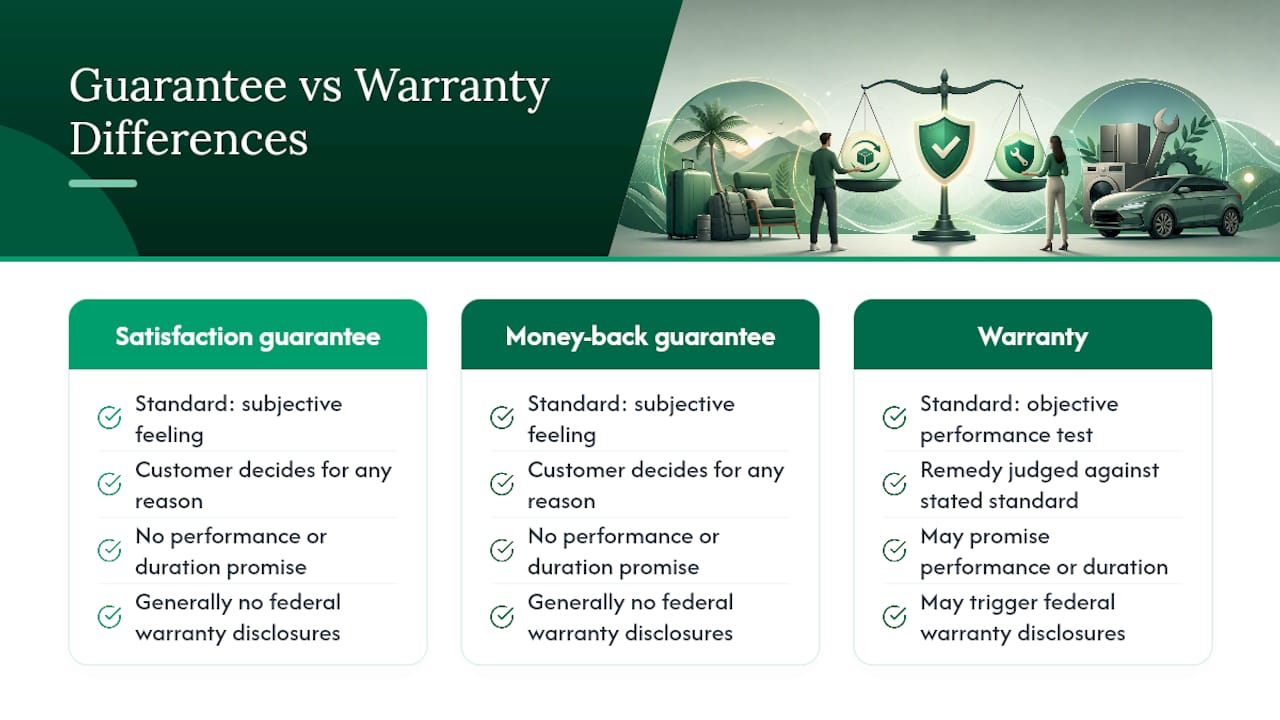
A money-back guarantee and a satisfaction guarantee are close cousins. Both let the customer decide, for any reason, that they want their money back. A warranty is different: it promises the product will perform to a specific standard for a specific time, and it’s judged against that standard, not against how the customer feels about it. “If you’re not happy, return it” is a satisfaction guarantee. “This blender motor will run for five years or we’ll repair it” is a warranty.
The line matters because of the Magnuson-Moss Warranty Act. Once a guarantee starts making performance or durational promises, such as “lasts 10 years” or “reduces energy costs by a set amount,” it can shift from a subjective satisfaction claim into a written warranty. That triggers additional disclosure requirements and a different set of consumer remedies if the product fails to perform.
A practical example: “Satisfaction guaranteed or your money back” stays firmly in FTC guarantee territory. “This roof coating will last 15 years” edges into warranty law, whether or not the seller intended it that way. The fix is straightforward. Decide which claim you’re actually making, write the guarantee to match, and loop in legal counsel before mixing performance language into what’s supposed to be a simple satisfaction promise. Getting the label wrong doesn’t just confuse customers. It can expose the business to obligations it never meant to take on.
What Federal Law Requires: FTC Rules on Satisfaction Guarantees
The core rule is short. 16 C.F.R. $239.3 says that if you advertise “satisfaction guaranteed” or similar language, you must be willing to refund the full purchase price at the buyer’s request, and you must disclose any material limitations on that promise clearly and prominently in the same advertising.
“Full purchase price” is usually read to mean what the customer actually paid for the product itself. Sales tax, shipping fees, and restocking charges sit in a gray area. Many businesses exclude original shipping costs from refunds, and that’s generally accepted, but only if the exclusion is disclosed up front rather than discovered at checkout. Burying a restocking fee in page-nine terms of service is precisely the kind of practice the rule was written to stop.
The FTC’s Businessperson’s Guide to Federal Warranty Law confirms the same standard: satisfaction and money-back claims should offer a genuine full refund, and any conditions need to be visible enough that a prospective buyer actually notices them before purchasing, not after.
Pro Tip: The FTC allows conditions like “return the unused portion within 30 days,” but the condition has to appear with the same visibility as the guarantee claim itself. A tiny footnote asterisk usually doesn’t meet that bar.
What generally satisfies the prominence requirement:
- The time window stated in the same breath as the guarantee (“30-day money-back guarantee”)
- A visible link to full terms placed near the guarantee claim, not buried in a footer
- Clear identification of what triggers forfeiture (used product, missing packaging, expired window)
What tends to trigger enforcement risk:
- Advertising “satisfaction guaranteed” with no refund mechanism actually in place
- Disclosing limits only after the customer has already paid
- Refusing refunds once a customer invokes the guarantee within its stated terms
Documenting your terms in writing, publishing them on a dedicated policy page, and training support staff to honor them consistently is the best defense against a complaint. When a company refuses to honor its own guarantee, customers can escalate through ReportFraud.ftc.gov, which the FTC treats as a signal for potential deceptive-advertising action.
How to Write and Display a Compliant Satisfaction Guarantee
Good guarantee copy does two things at once: it reassures the customer instantly and discloses the real conditions without making them hunt for a lawyer.
- Lead with the headline claim. “30-day money-back guarantee” or “100-night home trial” belongs in large, visible type, not a footnote.
- Put material limits in the same visual space. If returns require original packaging or a receipt, say so directly beneath the headline claim, not three clicks away.
- Link to full written terms. A short summary up front, with a clear link to the complete policy, satisfies both the customer’s need for quick reassurance and the FTC’s disclosure standard.
- Repeat the guarantee at every decision point. Product pages, checkout, ad creative, and packaging inserts should all carry the same claim and the same limitations, worded consistently.
- Name the remedy and the return method. Specify refund versus store credit versus replacement, and explain exactly how to initiate the process, whether that’s a prepaid label or an in-store return.
A few short examples show how this looks in practice: “Try it for 30 days. Not satisfied? Full refund, no questions asked. Item must be returned in original condition.” Or for a service: “We guarantee a response within 24 hours or your next invoice is 20% off. See full terms.” Each version puts the limitation right next to the promise instead of hiding it.
What a Satisfaction Guarantee Actually Costs a Business
The refund itself is rarely the biggest expense, as specialty resale sites like EagleSaver illustrate with their buyback guarantees and payout models. Reverse logistics, inspection labor, restocking, and customer support time typically add up to more than the refunded dollar amount, especially for physical products that require return shipping and a condition check before resale or write-off.
Fraud and abuse are real but manageable risks. Reasonable time windows, proof-of-purchase requirements, and a documented restocking policy stop the majority of opportunistic claims without punishing honest customers. Some businesses also cap free-return shipping after a certain number of claims per account to slow down repeat abuse.
Return on investment comes down to a simple comparison: does the conversion lift from offering the guarantee outweigh the cost of the refunds it generates? Mailchimp’s research on guarantee ROI points to a useful framing: a higher refund rate isn’t automatically a failure if the guarantee is also driving higher lifetime value from customers who now trust the brand enough to buy again.
Before rolling a guarantee out company-wide, pilot it:
- Test on one product line or a specific customer segment for 60 to 90 days
- Track refund rate, conversion rate, and repeat purchase rate side by side
- Compare the net margin impact, not just the refund total, before deciding to scale it
Guarantee Templates You Can Adapt Today
Copy-ready templates save time, but each one needs its disclosures built in from the start rather than patched on later.
30-day money-back template: “Buy with confidence. If you’re not satisfied within 30 days of delivery, return it for a full refund of the purchase price. Item must be in original condition with proof of purchase. Shipping costs are non-refundable. [Full terms link].”
90-day satisfaction with replacement option: “We stand behind this product for 90 days. If it doesn’t meet your expectations, choose a full refund, a free replacement, or store credit. Contact support to start your claim. [Full terms link].”
Try-before-you-buy trial template: “Try it risk-free for 60 nights. If it’s not right for you, we’ll arrange a free pickup and refund the full purchase price. One trial per household. [Full terms link].”
The pattern across all three: the headline promise and its main condition sit in the same paragraph, never separated by a scroll or a click. That’s what the FTC calls prominence, and it’s also just good customer communication.
Full written terms should live on a dedicated, linkable policy page, referenced consistently from product pages, order confirmation emails, and packaging inserts.
How to Measure If Your Guarantee Is Working
A guarantee is a business decision, not just a trust signal, so it needs the same testing rigor as a pricing change.
- Run an A/B test on the headline and duration. Compare a 30-day window against a 60-day window, or test “money-back” language against “satisfaction guaranteed” phrasing, on similar traffic segments.
- Track conversion rate and refund rate as your primary metrics. A guarantee that lifts conversion by more than it raises refunds is working.
- Watch NPS, repeat purchase rate, and average order value as secondary signals. These reveal whether the guarantee is building longer-term loyalty, not just short-term sales.
- Give the pilot at least one full sales cycle, generally 60 to 90 days, before making a keep-or-kill decision.
- Interpret jointly, not separately. A guarantee that raises refunds but also raises lifetime value from repeat buyers can still be a net win for the business.
When a Guarantee Helps and When It Backfires
Guarantees earn their keep on considered purchases with healthy margins: mattresses, electronics, professional services. They backfire on razor-thin-margin commodity goods, where even a modest refund rate erases the profit entirely. Before launching one, check that reverse logistics, inspection speed, and trained support staff can actually deliver on the promise. Buybackbear’s model, an upfront quote followed by a same-day payout and a certified NIST 800-88 data wipe, shows what a guarantee looks like when operations and legal language actually agree with each other.
, Andy
How Buybackbear Handles the Payout Promise It Makes
A satisfaction guarantee only means something if the business behind it can actually deliver the refund, the replacement, or the payout it promised, on time and without a fight. The model is built around that idea: get an instant quote, ship the device free, get it inspected, and get paid the same day, with real cash by PayPal, Venmo, debit card, or bank transfer instead of carrier bill credit spread across years.
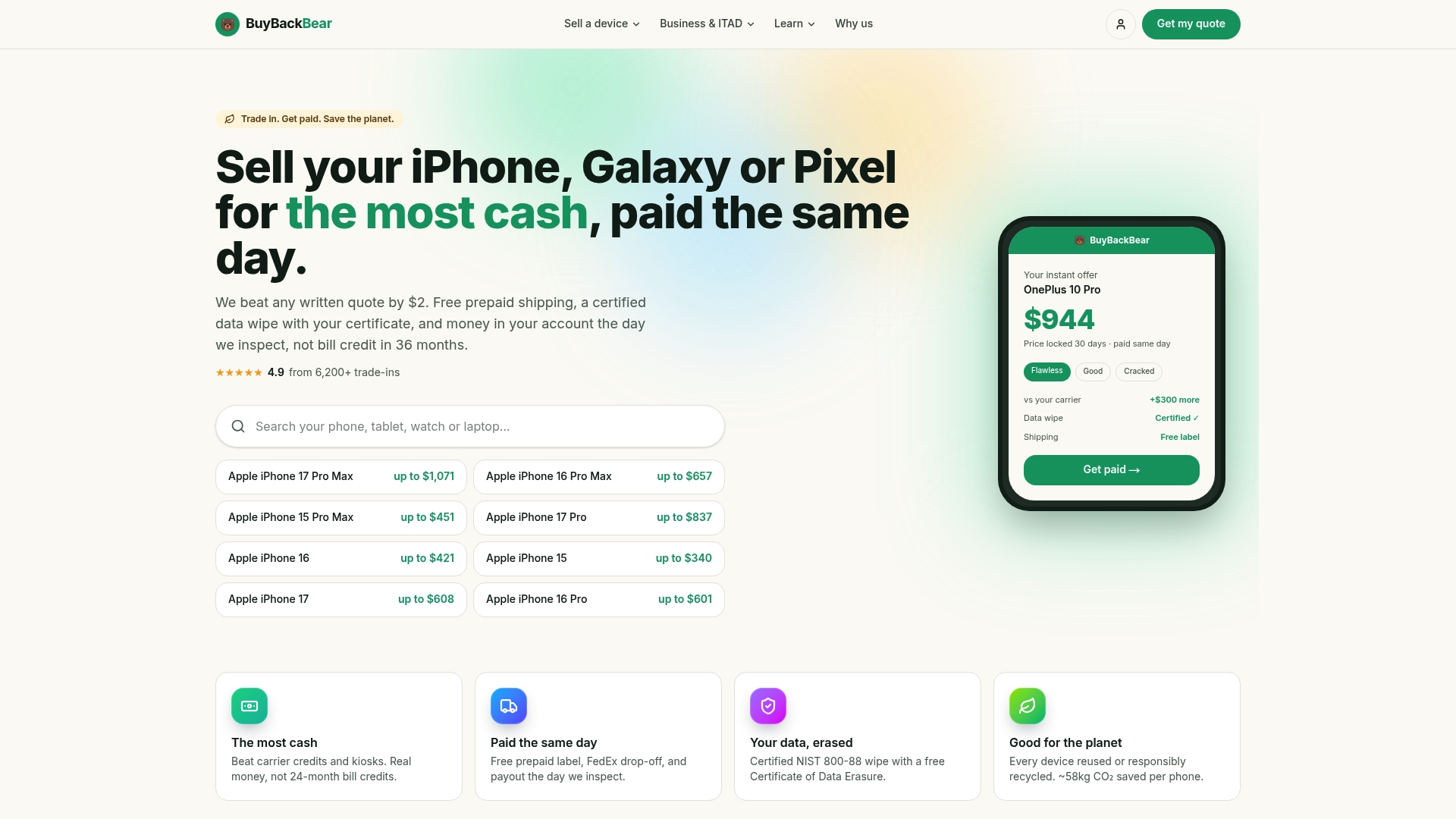
Devices are wiped to the NIST 800-88 standard with a free Certificate of Data Erasure, which matters as much for trust as for security. Vague data-handling promises are one of the most common sources of buyback disputes, and a certificate closes that gap before it opens. Competing buyback prices are checked daily and any written quote is beaten by a competitive amount so the payout promise has a number attached, not just a sentiment.
If you want to see what a clear, deliverable guarantee looks like in practice, get an instant quote for your device and check how the payout timeline compares to whatever guarantee language you’ve been reading on other sites.
Sources
For readers who want the source text rather than a summary, these are the primary references behind the guidance above:
- 16 C.F.R. $239.3 – “Satisfaction Guarantees” and similar representations in advertising
- Businessperson’s Guide to Federal Warranty Law | Federal Trade Commission
- 8 Types of Customer Satisfaction Guarantees That Work
FAQ
Can you give an example of a satisfaction guarantee?
A common example is “30-day money-back guarantee: return your purchase within 30 days in original condition for a full refund.” One clear example applies clarity to device buybacks: an instant quote, a same-day payout after inspection, and a certified data-wipe guarantee with no hidden fine print.
What are the three C’s of customer satisfaction?
Definitions vary across sources, but a common version centers on consistency, communication, and convenience, the idea that reliable service, clear updates, and an easy process drive satisfaction more than any single perk.
Can you give examples of guarantees besides money-back?
Yes. Free trials (try a mattress for 100 nights), lifetime guarantees on durable goods, best-price matching with a refund on the difference, and service guarantees tied to a specific performance metric are all common formats.
What are examples of strong customer satisfaction practices?
Prominent, easy-to-find guarantee terms, fast refund processing, and transparent communication about limitations before purchase all build measurable trust. Businesses that disclose conditions upfront, rather than after a customer already feels misled, tend to see fewer disputes and higher repeat purchase rates.
Does BuyBackBear offer a satisfaction guarantee on device buybacks?
Buybackbear’s model centers on transparent, same-day cash payouts after inspection and a certified NIST 800-88 data wipe with a free certificate, reducing the disputes that vague buyback promises typically cause. Current pricing and offer details are available directly on the Buybackbear site.
Recommended
Ready to sell?
Get an instant quote, free prepaid shipping, and fast cash that beats carrier trade-in credit.
Selling your device here, at a glance
Get my instant quote →- Instant quote in about 30 seconds, price locked while you decide
- Cash by PayPal, Zelle, Venmo or check after inspection, no fees
- Free prepaid label both ways, free return shipping if you decline
- We beat any competitor's written quote by $2
- Cracked screen, broken or won't power on? Still worth real money
- Certified NIST 800-88 data wipe with an emailed certificate
- Trade-in value paid in cash, not a 24-36 month carrier bill credit
- Every model priced: unlocked or carrier-locked, any storage size