Identity Verification: 4 Requests That Can Hold Up Your Payout
October 14, 2026

Most platforms will hold payouts until you complete identity and bank verification, so check the platform notice first, then upload matching ID and bank proof through the secure portal. The common requests include a government ID, bank account proof, and a tax identifier like an SSN, ITIN or EIN. If you already submitted documents, confirm every field matches exactly and wait out the platform’s review window before contacting support.
TL;DR:
- Document reviews commonly take 1 to 7 business days, and approved payouts are released within 3 to 5 business days afterward.
- Instant bank connections can clear in minutes, but manual deposits take up to three business days; wait until the full code posts before entering it.
- A sudden sales spike, repeated chargebacks, or a newly added bank account can trigger extra checks, and a banking partner may pause payouts independently.
- Changing verified bank details commonly pauses payouts for three to five business days while the platform confirms ownership of the replacement account.
- If the stated review window passes, preserve upload timestamps and contact support with your transaction ID, asking for supervisory review rather than resubmitting documents.
Table of Contents
- Documents platforms commonly request for payout verification
- Why platforms require identity verification before releasing funds
- How long verification and payout release typically take
- How to prepare and submit verification materials correctly
- Common verification failures and how to fix them quickly
- How to follow up and escalate if your payout stays on hold
- What years of payout holds have taught us
- How BuyBackBear handles payouts and identity checks for device sellers
- FAQ
- Sources
Documents platforms commonly request for payout verification
Platforms ask for a narrow set of documents, and most holds clear faster once you know exactly what counts as acceptable proof.
- A current, unexpired government photo ID such as a driver’s license, state ID or passport, photographed in full of all four corners visible.
- Bank verification through either instant account connection or a test deposit, which posts a small amount along with a 6-digit code to your statement.
- A Social Security Number or ITIN for individual sellers, or an Employer Identification Number with supporting IRS paperwork for business accounts.
- A selfie or short liveness check paired with your ID photo, used to confirm the person uploading the document matches the ID on file.
Selfie and liveness checks exist because a static ID photo alone can be copied or faked. Platforms pair the two so the system can confirm a live person matches the document, usually with simple instructions like blinking or turning your head.
Pro Tip: Upload documents only through the platform’s official verification portal. Shopify’s own account security guidance notes that documents sent through email or chat are often discarded or redacted for privacy reasons, so you’ll just have to resubmit anyway.
Why platforms require identity verification before releasing funds
Payment platforms aren’t being difficult for no reason. Financial institutions and the platforms that rely on them operate under a Customer Identification Program, which sets minimum standards for confirming who is receiving money through their systems.
- CIP minimums require collecting a name, date of birth, address and taxpayer identification number before a bank can form a reasonable belief about a customer’s identity.
- FinCEN’s interagency guidance allows both documentary methods, like an ID scan, and non-documentary methods, like data matching, depending on the institution’s risk assessment.
- Risk-based triggers, including sudden spikes in transaction volume, repeated chargebacks, or a new bank account on file, often prompt a platform to ask for extra documents beyond the initial setup.
Payment processors and the banks behind them can also layer on their own checks. A platform might clear your identity but still pause a payout because its banking partner flagged the transaction pattern independently.
How long verification and payout release typically take
Timelines vary, but most platforms follow a similar rhythm. Google’s Payments Center states that document review commonly takes 1 to 7 business days, with approved payouts released within 3 to 5 business days after that. Test deposits used for bank verification can take up to three business days to appear on a statement, while instant account connection methods clear in minutes when your bank supports them.

Changing your payout bank details after an account is already verified often triggers a fresh hold. Shopify’s payout timing guidance explains that updated bank information commonly causes a temporary 3 to 5 business day pause while the platform re-confirms ownership of the new account.
How to prepare and submit verification materials correctly
A clean submission on the first try saves you a week or more of back and forth.
- Open your account profile and compare every field, name spelling, punctuation, date of birth and address, against your ID exactly, including suite numbers or middle initials.
- Photograph your ID flat on a plain, neutral background, with all four corners in frame and no glare across the text or photo.
- Upload everything through the platform’s official verification portal rather than a support chat or email thread.
- For bank verification by test deposit, check your statement for the small deposit and copy the full 6-digit code exactly as it appears.
- If your business EIN won’t verify, request your SS-4 confirmation letter or a 147c letter from the IRS before resubmitting.
Pro Tip: If your bank statement shows fewer than six digits for a test deposit, wait. Google’s bank verification help notes that a truncated code usually means the deposit hasn’t fully posted yet, and entering it early just causes another failed attempt.
Reconciling your tax paperwork early also helps. If you’re a frequent seller approaching the reporting thresholds covered in the IRS’s Form 1099-K guidance, matching your legal name and tax ID across every platform account avoids a second round of document requests later.
Common verification failures and how to fix them quickly
Most rejected submissions trace back to a handful of repeatable problems.
- Mismatched names: a nickname, maiden name, or missing suffix on your profile versus your ID. Fix it by updating the account field to match the ID exactly, or submit a supporting document like a marriage certificate if the names are both legally valid.
- Expired or blurry ID images: retake the photo in daylight, hold the camera steady, and make sure the full document, not just the photo area, is visible.
- Bank account or routing errors: double check every digit against a voided check or your bank’s app, and confirm the account’s country matches the currency the platform expects.
- Tax ID mismatches: if your SSN, ITIN or EIN doesn’t match IRS records, request the appropriate confirmation letter and update your account entry rather than resubmitting the same number.
- Unusual activity flags: when a platform asks for more detail about recent transactions, a short written explanation with order numbers or screenshots usually resolves it faster than a vague reply.
Shopify’s identity verification guidance points to inconsistent data across your ID, bank records and account profile as the most common failure pattern, and reconciling those three sources is the fastest fix available to you.
How to follow up and escalate if your payout stays on hold
If a hold lasts longer than the platform’s stated window, work through a clear escalation path instead of resubmitting the same documents repeatedly.
- Reread the original notification in your account dashboard or email. Shopify notes that this message is the canonical instruction for resolving most holds.
- Save screenshots or timestamps of every document you uploaded. Shopify’s account holds guidance notes that proof of submission resolves a large share of disputes about whether a document was received.
- Contact support with your transaction ID, upload timestamps and a brief summary, and ask for supervisory review if the first response doesn’t move things forward.
- If a tax mismatch or legal question comes up, loop in an accountant. A 1099-K reconciliation checklist from Kelli Works walks through matching your records before filing, which can head off a second verification request.
What years of payout holds have taught us
The fastest payouts never come from arguing with support. They come from matching your name, address and tax ID exactly before you hit submit, because that single step prevents most holds in the first place.
Here’s a one-minute checklist: open the notification, confirm every field matches your ID, retake any blurry document, check your bank statement for the full micro-deposit code, then follow up with support if nothing moves within the stated window. Sellers who skip straight to a support ticket usually wait longer than sellers who fix the mismatch first.
, Andy
How BuyBackBear handles payouts and identity checks for device sellers
Selling a device for cash shouldn’t come with the same paperwork maze as a marketplace payout hold. When you sell your device for cash with us, we pay the same day we inspect it, by PayPal, Venmo, debit card or bank transfer, with no contract and no bill credit spread over years.
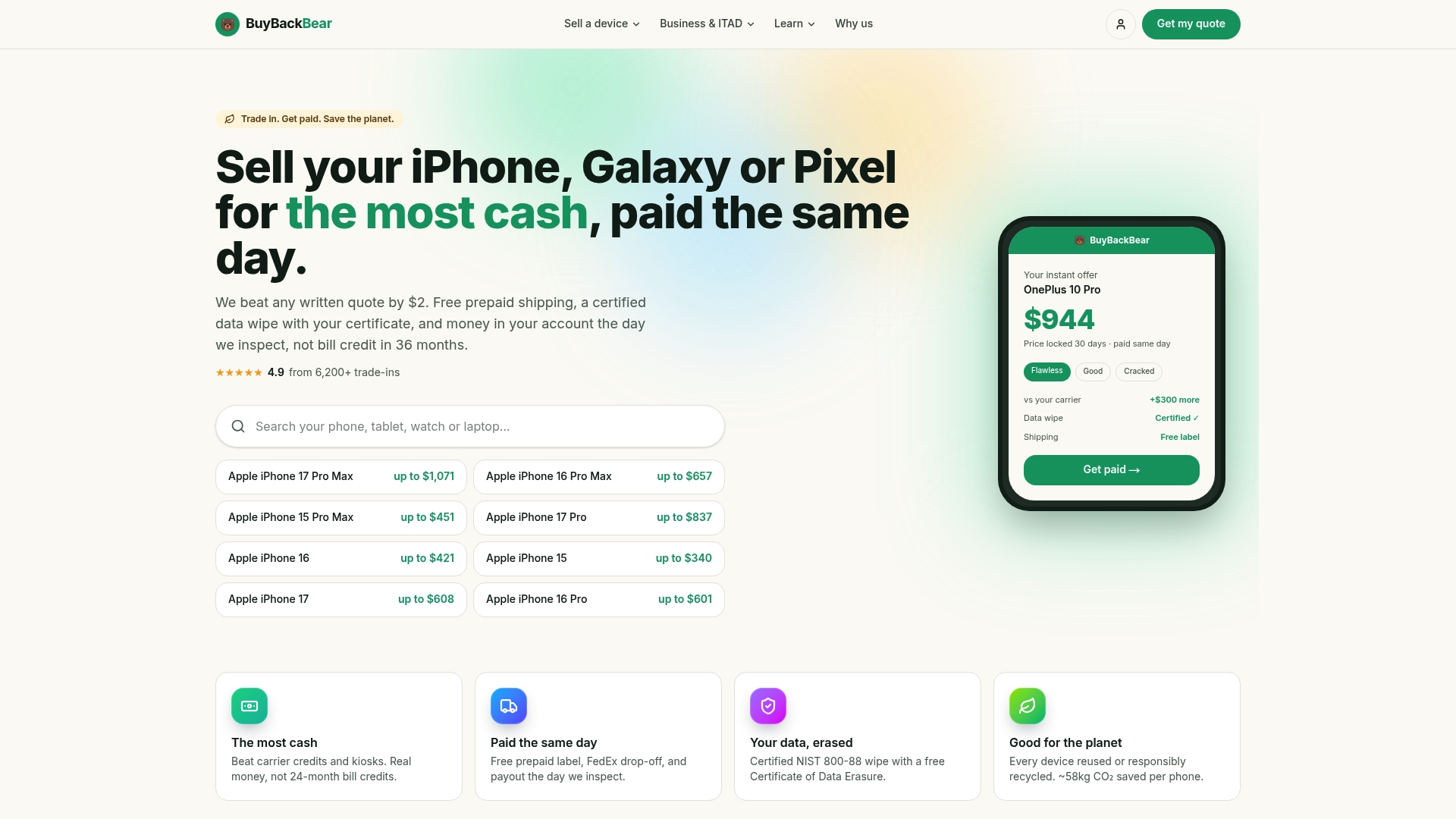
Before you start, it helps to have a few things ready:
- A device that’s been backed up and signed out of any cloud or carrier accounts.
- Your preferred payout method on hand (PayPal, Venmo, debit card or bank transfer).
- Any original packaging or accessories, which can factor into your quote.
Every device we buy gets wiped to the NIST 800-88 standard, and we send a free Certificate of Data Erasure so you have documented proof your personal data is gone, a useful record if you ever need to show a device was properly sanitized. Our data erasure certificate explains what that process covers. If you’re clearing out a drawer of old phones or retiring a small fleet of laptops, our buyback electronics page walks through how the process works from quote to payout. Get your instant quote and ship free with a prepaid label whenever you’re ready.
FAQ
Why is Facebook forcing me to upload my ID?
Platforms request ID uploads to meet identity verification standards tied to Customer Identification Program rules, especially once an account reaches a certain transaction volume or triggers a fraud review. This is a standard compliance step across most payment platforms, not a sign your specific account did anything wrong.
How do you skip verifying your identity on Apple Pay?
There’s no way to skip identity verification when it’s required for a payment or payout feature, since that check protects both you and the platform from fraud. The practical path forward is completing the requested verification step rather than looking for a workaround.
How long does GPay verification take?
Document review for payment platform verification commonly takes 1 to 7 business days, with approved payouts typically released within 3 to 5 business days after that. Instant bank connection methods, when available, clear much faster than manual test deposits.
How long after identity verification will I get my refund?
Refund timing depends on the specific platform and payment method, but once identity verification clears, most platforms process the next payout within their standard release window of 3 to 5 business days. Check your platform’s payout settings page for the exact window that applies to your account.
Sources
- Google Payments Center, merchant verification and payouts
- IRS. Understanding your Form 1099‑K
- FinCEN. Interagency interpretive guidance on CIP
- Shopify Help Center, account security and document handling
Recommended
Ready to sell?
Get an instant quote, free prepaid shipping, and fast cash that beats carrier trade-in credit.
Selling your device here, at a glance
Get my instant quote →- Instant quote in about 30 seconds, price locked while you decide
- Cash by PayPal, Zelle, Venmo or check after inspection, no fees
- Free prepaid label both ways, free return shipping if you decline
- We beat any competitor's written quote by $2
- Cracked screen, broken or won't power on? Still worth real money
- Certified NIST 800-88 data wipe with an emailed certificate
- Trade-in value paid in cash, not a 24-36 month carrier bill credit
- Every model priced: unlocked or carrier-locked, any storage size