7 ITAD Must Dos: Get Per Device NIST Certificates for Small Businesses
September 15, 2026
If you run a small business, adopt a simple documented ITAD process: inventory every retiring device, sanitize it to a NIST SP 800-88 standard, and require a per-device certificate from a certified partner or a reputable buyback service. That sequence closes the security gap most small companies leave open when a laptop or phone leaves the building, and it takes hours, not weeks, to set up. Start by pulling your current device list and flagging anything scheduled for retirement this quarter.
TL;DR:
- Small businesses should implement a documented ITAD process that includes inventory, sanitization to NIST standards, and certification from a reputable vendor.
- Proper chain-of-custody and comprehensive records are essential to meet legal and compliance requirements, especially for sensitive data.
- Vendors with active certifications such as R2v3, e-Stewards, and NAID AAA offer accountability and proven responsible handling of electronics disposal.
- Buyback programs like Buybackbear provide certified data wiping and cash recovery for outdated but functional devices, reducing clutter and increasing assets.
- Retaining detailed documentation and certificates for several years ensures readiness for audits, legal claims, and demonstrating security to stakeholders.
Table of Contents
- What Does ITAD Actually Cover?
- Why Does ITAD Matter for a Small Business?
- How Do You Run the ITAD Process Step by Step?
- 7 Practical Must-Dos You Can Implement Today
- What Should You Require From an ITAD Vendor?
- How Does Buybackbear Support Small-Business ITAD Needs?
- Framing ITAD as a Security Control, Not a Cleanup Chore
- Get a Quote and Turn Retired Devices Into Cash
- Where to Verify ITAD Standards and Certifications
- Sources
- FAQ
What Does ITAD Actually Cover?
IT asset disposition (ITAD) is the managed end-of-life process for retired hardware. It covers everything from the moment a laptop, server, or phone stops being useful in daily operations to the moment it’s either wiped and resold, donated, or physically destroyed. That process includes sanitization, chain-of-custody tracking, and documentation proving what happened to each device.
This is where ITAD parts ways with ordinary recycling. Curbside or bulk electronics recycling focuses on keeping materials out of landfills; it says nothing about whether the hard drive inside still holds customer records. ITAD treats data security and material recovery as two separate jobs that both have to get done, and it produces a paper trail an auditor or insurer can actually check.
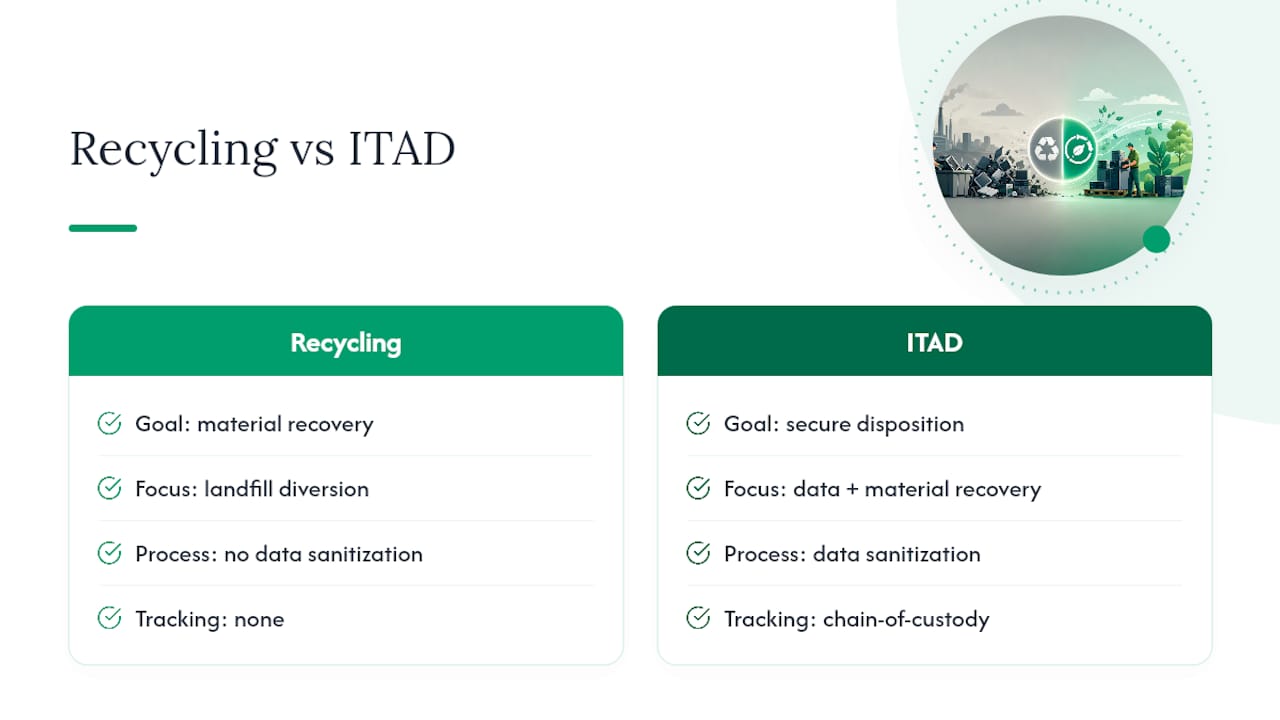
Small businesses typically need to think about this for laptops, desktops, smartphones, tablets, external drives, servers, networking gear, and even office printers with onboard storage. Any device that ever touched customer data, payment information, or internal files belongs in the ITAD conversation, not the junk drawer.
Why Does ITAD Matter for a Small Business?
The risk isn’t theoretical. Industry reporting has repeatedly found that a large share of organizations fail to properly wipe or destroy decommissioned devices before they leave company control, and that gap is exactly where breaches start, according to Forbes. A single laptop sold on a resale site with an intact hard drive can expose years of client files, tax records, and login credentials.
Statistic Callout: Forbes Technology Council members report that improperly sanitized decommissioned devices remain a persistent and widespread security vulnerability across organizations of every size, not just enterprises.
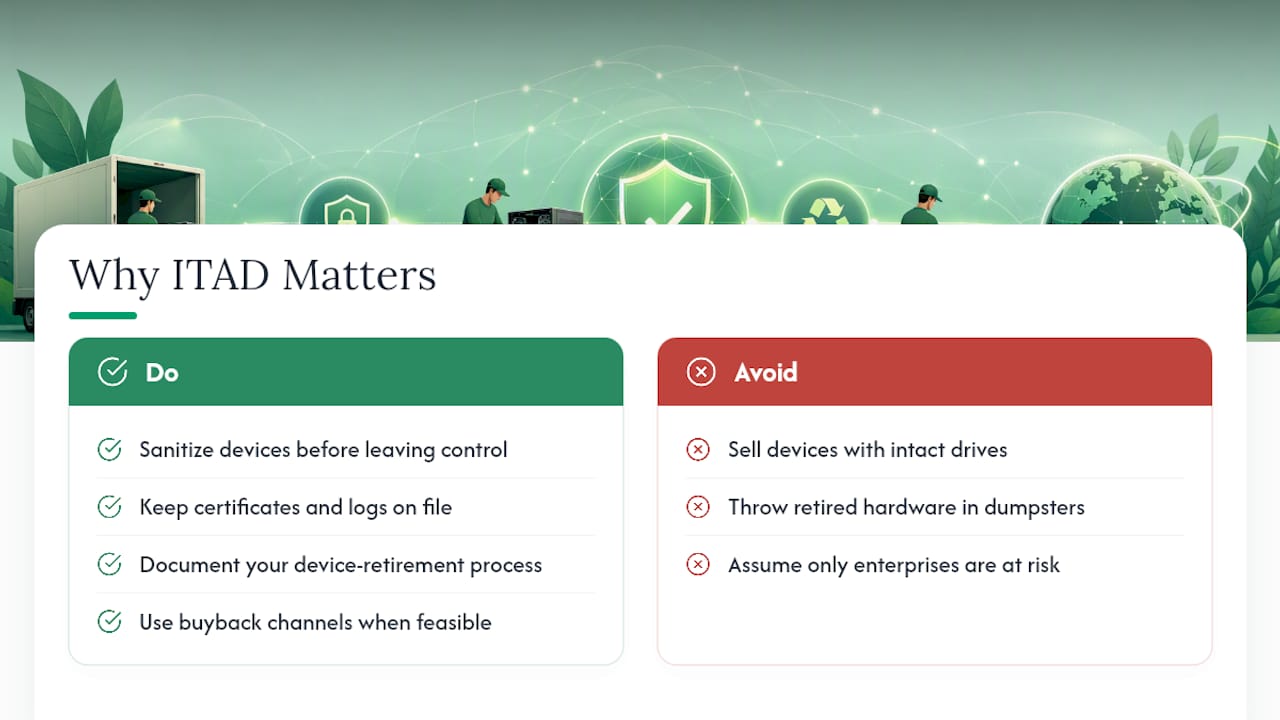
For businesses handling health records, card payments, or client financial data, HIPAA, PCI DSS, and state privacy laws all create documentation expectations around how retired devices get sanitized. You don’t need a compliance department to meet these. You need a folder of certificates and logs you can produce on request.
The upside runs the other direction too. A documented process reduces breach exposure and audit stress, and depending on your hardware’s age and condition, retiring devices through a buyback channel instead of a dumpster can put real cash back into the business.
How Do You Run the ITAD Process Step by Step?
A workable ITAD process for a small business breaks into five stages. None of them require a dedicated IT security hire.
- Inventory. Log every device’s serial number, asset tag, assigned user, and physical condition before it leaves service. A spreadsheet works fine at this scale.
- Classify. Match each device to a data sensitivity level. A shared conference-room laptop is not the same risk as a finance manager’s machine that touched payroll files.
- Sanitize. Apply the NIST SP 800-88 outcome that fits: Clear for low-risk reused devices, Purge (often crypto-erase or firmware secure-erase) for confidential data on SSDs and NVMe drives, and Destroy for high-risk or unreadable media. Removable media and old spinning hard drives usually call for physical destruction if resale isn’t planned.
- Log chain of custody. Record who picked up the device, how it was transported, and who received it at the processing site. This is the log an auditor asks for first.
- Dispose. Decide reuse, resale, or recycling, and collect the output that proves it happened: a per-device certificate of data erasure or destruction.
Firmware-level secure erase is generally the most practical Purge method for SSDs, since older overwrite techniques designed for spinning drives don’t reliably reach flash storage. Whatever method you pick, keep the verification log, not just the vendor’s word.
7 Practical Must-Dos You Can Implement Today
You don’t need a formal security program to close most of your ITAD risk. Seven habits cover the bulk of it, and they line up with what practitioner guides across the industry, including Iron Mountain’s small-business ITAD checklist, consistently recommend.
- Write a one-page ITAD policy and name one person who owns it.
- Fold device retirement into your offboarding and procurement checklists so nothing slips through when an employee leaves.
- Keep a running asset register and physically tag devices the moment they’re marked for retirement.
- Require sanitization evidence for every device, and spot-check a sample rather than trusting a blanket claim.
- Use sealed transfer bins and named, logged handlers whenever devices move between locations.
- Decide reuse versus destroy using the NIST mapping, not gut feel: a three-year-old laptop with a clean SSD is often worth wiping and reselling.
- Review the policy twice a year and keep records for the length of any related contract plus several extra years in case of a claim or audit.
Pro Tip: Keep a “retirement folder” per device, physical or digital, with the certificate, the chain-of-custody log, and a photo of the asset tag. When an auditor asks for proof six months later, you want to hand over a file, not reconstruct a timeline from memory.
What Should You Require From an ITAD Vendor?
Certifications tell you whether a vendor is accountable to an outside standard, not just its own marketing page. Three matter most:
- R2v3 (SERI), the current industry benchmark for responsible electronics reuse and recycling, verifiable directly through Sustainable Electronics Recycling International.
- e-Stewards, which sets environmental and ethical handling criteria and is worth checking through the e-Stewards standard registry.
- NAID AAA, focused specifically on data destruction and sanitization audit practices.
Beyond the certificate itself, ask whether the vendor still holds active status, not a badge from three years ago. Confirm they issue a per-device certificate of data erasure or destruction, offer some form of tracking portal or reporting dashboard, and can name their downstream partners if they subcontract any part of the process.
- Ask for proof of errors-and-omissions or cyber liability insurance before you ship a single pallet.
- Reserve the right to sample-verify a subset of devices against their reported sanitization method.
- Put the exact sanitization method, not just “NIST-compliant,” in the statement of work.
- Treat a vendor who won’t name subcontractors, or who describes their process only as “secure wipe” with no method attached, as a red flag worth walking away from.
How Does Buybackbear Support Small-Business ITAD Needs?
Buybackbear buys back bulk devices from small businesses, wipes every unit to the NIST 800-88 standard, and issues a free per-device Certificate of Data Erasure.
Full destruction still makes sense for drives that are physically damaged, unreadable, or holding data too sensitive to trust to any sanitization method. But for a fleet of working laptops or phones that are simply outdated, a buyback route lets a small business recover cash while still getting the certified wipe an auditor wants to see. It’s a middle path between paying for destruction and letting devices sit in a closet unaccounted for, one covered in more detail on Buybackbear’s ITAD page.
Framing ITAD as a Security Control, Not a Cleanup Chore
Treating retired hardware as a security control instead of an afterthought is the single biggest shift a small business can make here. Every device that leaves your building unaccounted for is an open door, and the cost of closing it properly is a fraction of what a breach costs later. Pull your device list this week and get a quote from a certified vendor before the next laptop leaves the building.
, Andy
Get a Quote and Turn Retired Devices Into Cash
Buybackbear offers small businesses an alternative to sitting on a closet full of retired laptops and phones: a service that provides a certified wipe, a certificate, and payment after device inspection.

The process runs in four steps. Get an instant online quote for your fleet, ship free using a prepaid label, let Buybackbear inspect the devices and confirm the offer, then get paid by PayPal, Venmo, debit card, or bank transfer with no contract attached. Everything runs through Buybackbear’s bulk business buyback program, and every device gets wiped to the NIST 800-88 standard with its own certificate, the same evidence your vendor checklist should already be demanding. If you’re still building out your sanitization documentation, the certified data destruction page walks through exactly what’s included per device.
Before you ship anything to any vendor, confirm active certification status and ask for a sample certificate up front, not after the pallet leaves your loading dock. Start by requesting a quote for your current batch of retiring devices.
Where to Verify ITAD Standards and Certifications
- NIST SP 800-88 defines the Clear, Purge, and Destroy sanitization outcomes referenced throughout this guide.
- R2v3 through SERI lets you confirm whether a vendor’s recycling certification is current.
- The e-Stewards standard covers environmental and ethical handling criteria worth checking alongside data-security credentials.
- Compliance guidance on per-device documentation outlines what auditors typically expect to see.
Sources
- NIST Special Publication 800-88 Rev. 1: Guidelines for Media Sanitization
- Welcome to R2v3. Sustainable Electronics Recycling International
- The e-Stewards Standard
- Don’t Let Your Decommissioned IT Assets Come Back To Haunt You. Forbes
- IT Asset Disposition: The Compliance Guide for Mid-Market IT Teams. Disposition Compliance
FAQ
What Is an ITAD Business?
An ITAD business manages the secure end-of-life process for retired electronics, including data sanitization, chain-of-custody tracking, and disposition through resale, recycling, or destruction, backed by documentation like per-device certificates.
What Is the ITAD Process?
The ITAD process runs through five stages: inventory, classification by data sensitivity, sanitization mapped to a NIST SP 800-88 outcome, chain-of-custody logging, and final disposition with a certificate proving what happened to each device.
What Is an ITAD Service?
An ITAD service is a vendor or partner, certified or otherwise vetted, that handles device sanitization, tracking, and disposition on a business’s behalf, delivering documentation the business can hand to an auditor or insurer.
How Long Should a Small Business Keep ITAD Records?
Retain sanitization certificates and chain-of-custody logs for the length of any related contract plus several additional years to cover potential audits or claims.
Is a Buyback Service a Legitimate ITAD Option?
Yes, when it includes certified sanitization and per-device certificates. Buybackbear wipes devices to the NIST 800-88 standard and issues a free certificate per unit, making it a practical option for businesses that want cash recovery alongside compliant data destruction.
Recommended
Ready to sell?
Get an instant quote, free prepaid shipping, and fast cash that beats carrier trade-in credit.
Selling your device here, at a glance
Get my instant quote →- Instant quote in about 30 seconds, price locked while you decide
- Cash by PayPal, Zelle, Venmo or check after inspection, no fees
- Free prepaid label both ways, free return shipping if you decline
- We beat any competitor's written quote by $2
- Cracked screen, broken or won't power on? Still worth real money
- Certified NIST 800-88 data wipe with an emailed certificate
- Trade-in value paid in cash, not a 24-36 month carrier bill credit
- Every model priced: unlocked or carrier-locked, any storage size