Consumers: Quote-Beat Checklist with FTC & NIST Proof and Device Case
October 5, 2026

A quote beat policy is a seller’s written promise to beat a competitor’s price if you provide proof of that offer, and the single most important thing you can do is get the competitor quote in writing and confirm the total delivered cost before you trust the promise. The FTC requires that comparative price claims be truthful and backed by a reasonable basis, so a legitimate offer should hold up to scrutiny.
TL;DR:
- Confirm that competitor quotes are current, written, and match your device’s model, condition, quantity, and included services to ensure eligibility.
- Add up all costs, including shipping, taxes, fees, and surcharges, because the total delivered cost determines if a quote qualifies for a price beat.
- Provide clear documentation, such as screenshots, serial numbers, and itemized prices, to substantiate your claim and prevent delays.
- Sellers are not legally required to beat a quote and may decline if the offer involves non-standard conditions, limited terms, or geographic restrictions.
- At BuyBackBear, we offer a a competitive amount price beat on verified, current competitor quotes for comparable devices, with secure device sanitization and prompt payment.
Table of Contents
- What a quote beat policy actually is
- Exactly what to check before you ask a seller to beat a quote
- What to submit: documentation and evidence that proves the competitor quote
- Limitations, legal context, and FTC guidance buyers should know
- Example: how a quote beat policy looks in device buybacks
- Negotiating with proof, not pressure
- How BuyBackBear applies a quote beat guarantee to device sellers
- FAQ
- Sources
What a quote beat policy actually is
A quote beat policy comes in two common forms: match, where a seller agrees to equal a competitor’s price, and beat, where the seller promises to go lower, often by a fixed dollar amount or a percentage. “Match my competitor’s a competitive amount offer” and “beat any quote by a competitive amount” describe two different commitments with different math behind them.

These are voluntary, conditional commercial promises, not legal entitlements. A seller sets its own terms for what counts as a qualifying quote, and nothing obligates any business to offer this kind of guarantee at all.
This differs from a blanket “lowest price” claim, which asserts the seller already beats the entire market without requiring proof from you. A quote beat policy instead shifts the burden to you: you have to produce a comparable offer before the promise applies. That distinction matters when you are deciding how much homework to do before you ask.
Exactly what to check before you ask a seller to beat a quote
Before you submit a competitor quote, confirm it actually qualifies. Sellers reject mismatched comparisons constantly, and a little verification work up front saves a round of back-and-forth.
- Check that the model, specs, condition, quantity, and service scope match exactly between the two offers.
- Confirm whether the competitor quote must be written, dated, current, and final, rather than a rough estimate.
- Find out whether the beat is a fixed dollar amount or a percentage, and whether there is a cap.
- Add up the total delivered cost, including shipping, taxes, fees, installation, or restocking charges.
- Look for common exclusions like membership pricing, bundle deals, clearance stock, or geographic limits.
The FTC’s consumer guidance recommends comparing total cost rather than headline price, since a lower sticker price can disappear once shipping or fees get added back in.
Pro Tip: Screenshot the competitor’s offer page the moment you see it: prices and stock change fast, and a dated screenshot is stronger proof than a verbal recollection.
What to submit: documentation and evidence that proves the competitor quote
A seller can only evaluate a quote beat request if you give them something concrete to check. Vague descriptions slow everything down.
- Save the full competitor quote, itemized, or a screenshot showing the date, time, and URL.
- Record the exact model, serial number or storage size, carrier lock status, included accessories, and condition.
- Note every price component separately: tax, shipping, fees, warranty terms, and the quote’s expiration date.
- Ask whether the seller accepts preliminary online estimates or only inspected, finalized offers.
That last point matters for devices especially. A quote generated instantly online is often provisional until someone physically checks the item, and a seller’s beat policy may only apply once both offers are on equal footing: inspected against inspected, or estimate against estimate.
Limitations, legal context, and FTC guidance buyers should know
Comparative price claims fall under established consumer protection rules. The FTC’s policy on comparative advertising treats these claims as acceptable and even useful to shoppers, provided the seller has a reasonable basis for the comparison and discloses material limitations clearly and conspicuously.
There is no general law that forces any seller to beat a competitor’s quote. The FTC’s small business advertising guidance confirms that a quote beat promise is a voluntary offer, and the seller’s own written terms define exactly when it applies. A seller can legitimately decline to beat a quote that involves non-comparable condition, a membership-only price, limited inventory or timing, or a competitor outside its normal service area.
If a claim looks deceptive, such as a “beat any price” banner with no real path to redeem it, document what you saw, when you saw it, and whether the seller tried to walk it back. The FTC’s advertising substantiation policy expects companies to have evidence supporting a claim before they make it, not after a customer complains. Keeping your own paper trail puts you in a stronger position if you need to dispute a denied request.

Example: how a quote beat policy looks in device buybacks
Device buyback is a useful case study because the promise, the inspection, and the payout all happen in a short window. A typical sequence looks like this:
- You submit a competitor’s written quote for your phone, tablet, or laptop.
- You ship the device using a prepaid label.
- The buyer inspects the device against the condition you described.
- You get paid, often the same day inspection finishes.
Inspection is where offers most often move. A scratch you didn’t mention, a locked carrier, or a missing accessory can change the final number, which is why documenting condition before you ship reduces surprises later. One recurring issue in this space is the gap between an online estimate and the final inspected offer, something our own trade-in value research examines in detail.
Data erasure is the other piece worth checking. NIST SP 800-88 Rev. 2 defines media sanitization as making data recovery infeasible for a given effort level, and it recommends documented certificates as proof the wipe actually happened. When a buyer promises a higher payout through a beat policy, a matching data-erasure certificate tells you the extra money didn’t come at the cost of a shortcut on security.
Negotiating with proof, not pressure
The use in a quote beat negotiation sits entirely with your documentation. Save everything, stay polite, and be ready to walk if a seller can’t substantiate its own promise. A slightly lower headline number from a seller who pays fast and proves every step often beats a bigger number with vague terms attached.
, Andy
How BuyBackBear applies a quote beat guarantee to device sellers
We track buyback prices across the market every day, and when you send us a written, current competitor quote for a comparable device, we offer a price beat. Once we inspect your device and confirm the offer matches what you described, we pay promptly by electronic payment methods, with no bill credit spread over years like a carrier trade-in.
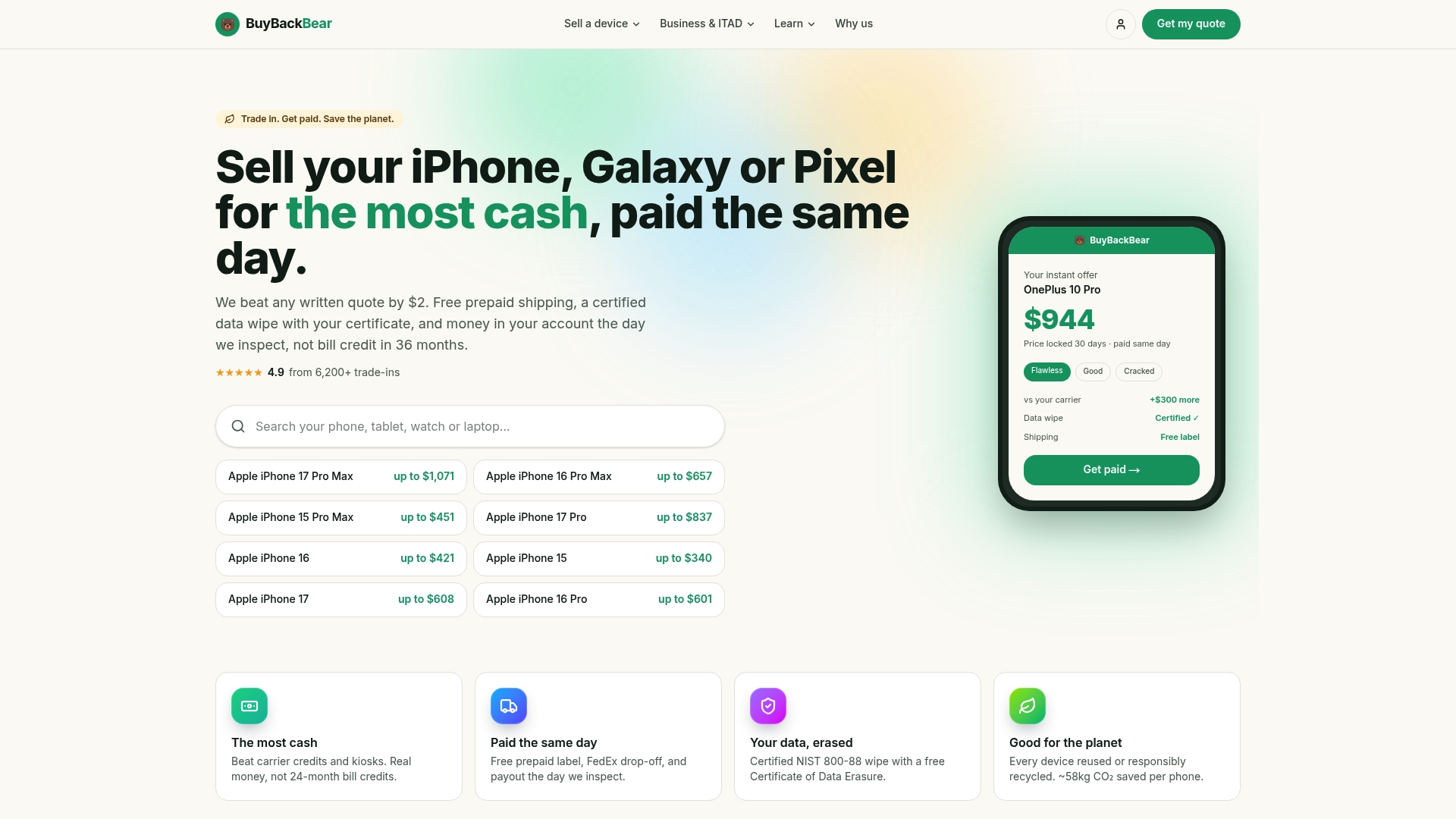
Every device gets wiped to the NIST 800-88 standard with a free Certificate of Data Erasure, so a higher payout never means skipping the security step. To get started:
- Grab an instant quote for your phone, tablet, laptop, or wearable.
- Attach the competitor’s written, dated quote with model and condition details.
- Ship free with our prepaid label and get paid after inspection.
Whether you’re clearing out a single iPhone or retiring a full fleet of business laptops, our sell page is where the process starts.
FAQ
What is a quote in a price-beat policy?
A quote, in this context, is a competitor’s written, dated price offer for a comparable product or service that you submit as proof so a seller can match or beat it. The FTC treats these comparisons as valid only when the underlying claim is truthful and the terms are clearly disclosed.
What makes a quote beat policy trustworthy?
A trustworthy policy spells out exactly what counts as an eligible competitor offer, the beat amount or percentage, and how taxes, shipping, and fees factor into the comparison. Clear, conspicuous terms are what the FTC’s advertising guidance expects from any seller making this kind of comparative claim.
What is the rule for accepting a competitor’s quote?
There’s no universal legal rule requiring any seller to accept a competitor quote; it’s entirely up to the seller’s own written terms, as the FTC’s small business guidance confirms. Most sellers require the quote to be current, written, and for a genuinely comparable item or service.
How long is a quote valid before it expires?
Quote validity is set by the individual seller, not by a general legal deadline, and often depends on inventory, pricing changes, or inspection results. Some transactions, like mortgages, carry specific regulated timelines, but most retail and buyback quotes expire whenever the seller’s terms say they do.
Does BuyBackBear beat competitor device buyback quotes?
Yes, we beat any written, current competitor quote for a comparable device by a competitive amount once we confirm the details match through inspection. You can submit your quote when you request an instant offer on your device.
Sources
- Statement of Policy Regarding Comparative Advertising | Federal Trade Commission
- FTC consumer guidance and resources
- Guidelines for Media Sanitization (NIST SP 800-88 Rev. 2)
Recommended
Ready to sell?
Get an instant quote, free prepaid shipping, and fast cash that beats carrier trade-in credit.
Selling your device here, at a glance
Get my instant quote →- Instant quote in about 30 seconds, price locked while you decide
- Cash by PayPal, Zelle, Venmo or check after inspection, no fees
- Free prepaid label both ways, free return shipping if you decline
- We beat any competitor's written quote by $2
- Cracked screen, broken or won't power on? Still worth real money
- Certified NIST 800-88 data wipe with an emailed certificate
- Trade-in value paid in cash, not a 24-36 month carrier bill credit
- Every model priced: unlocked or carrier-locked, any storage size