Ship a Phone Safely: NIST Wipe, DOT Battery Rules, 2 Inches Cushioning
September 3, 2026
The safest way to ship a phone is to wipe it using purge-level sanitization, remove the SIM and accounts, then double-box it with at least 2 inches of cushioning and ship it ground with the correct battery markings. If you’d rather skip the packing altogether, BuyBackBear sends a free prepaid label and handles the NIST 800-88 wipe for you after pickup.
TL;DR:
- Shipping a phone safely requires purge-level data sanitization, removing accounts, and double-boxing with at least 2 inches of cushioning for impact protection.
- Using ground shipping options like USPS Ground Advantage minimizes battery-related restrictions and reduces costs compared to air transport.
- Proper labeling, packaging, and documentation of IMEI and serial numbers are essential, especially for batteries close to or above regulatory weight thresholds.
- Damaged or swollen batteries must only travel by ground or rail and require specialized, compliant packaging to prevent fire risks.
- Photographing every shipping stage and keeping proof of data wipe and device details ensures better protection against loss, damage, or disputes.
Table of Contents
- Pre-Ship Checklist: Wiping Your Phone and Removing Your Data
- How Do You Pack a Phone So It Survives Shipping?
- What Are the Lithium Battery Rules for Shipping a Phone?
- Should You Ship Ground or Air, and Do You Need Insurance?
- How Do You Ship Damaged Batteries or Bulk Device Shipments?
- What Should You Do If Your Phone Is Lost or Damaged in Transit?
- Why Sellers Overestimate the Risk of Shipping a Phone
- Skip the Packing Tape: Ship Your Phone Free With BuyBackBear
- Where to Verify Current Shipping Rules
- Sources
- FAQ
Pre-Ship Checklist: Wiping Your Phone and Removing Your Data
Before any tape touches the box, get your data off the device and your accounts off your name with this step-by-step guide to phone recovery data. Skipping this step is how people accidentally sell their iCloud photos along with their old iPhone.
Start with a full backup. Export contacts, photos, and any app data you care about, then sign out of iCloud, Google, or Samsung accounts entirely. A device still tied to an account can trigger activation lock, which makes it worthless to a buyer and a headache to reset later.
For the wipe itself, NIST SP 800-88 Revision 2 recommends purge-level sanitization, not a basic factory reset. That means cryptographic erase or a manufacturer-supported factory sanitize, since standard overwrites can leave recoverable data sitting in wear-leveled storage areas on modern flash memory. If the device won’t power on or the storage is physically damaged, destruction is the only compliant option.
Run through this before you pack anything:
- Back up photos, contacts, and app data to cloud or computer storage.
- Sign out of iCloud, Google, or Samsung accounts and disable Find My Device.
- Remove the physical SIM card and deactivate the eSIM, since a live eSIM can block reactivation for the next owner.
- Run a factory reset or certified wipe, whichever fits the device’s condition.
- Photograph the IMEI, serial number, and any cosmetic damage for your records.
That last step matters more than people think. If a shipment gets lost or a buyback offer gets disputed, a timestamped photo of the IMEI is your fastest proof of what you shipped.
How Do You Pack a Phone So It Survives Shipping?
Phones die in transit from crushing, not from the trip itself. Sorting machines toss packages, stack them, and drop them from waist height without much ceremony, so your packing job is really a shock-absorption job.
Gather these materials first:
- Anti-static bubble wrap or an anti-static bag if any part of the phone (like a cracked-open back panel) exposes internal components. Standard bubble wrap can generate static that damages boards, so professionals stick to anti-static (usually pink or silver) material for anything exposed, according to UPS packaging guidance.
- A small rigid inner box or padded mailer sized just larger than the phone itself.
- An outer corrugated box with room for at least 2 inches of cushioning on every side, not just top and bottom.
- Air pillows, foam, or crumpled kraft paper to fill dead space. Never use loose packing peanuts alone against a bare screen.
- 2-inch pressure-sensitive packing tape, never string or twine, which can catch in conveyor equipment.
Here’s the actual sequence: wrap the phone in anti-static material if needed, center it in the small inner box, and pack cushioning tight enough that the phone can’t shift when you shake the box gently. Seal that inner box, then set it inside the outer box surrounded by another 2-inch layer of cushioning on all sides. Tape every seam with full-length strips, not just a few pieces in the middle. The box shouldn’t bulge or flex when you press on it.
Pro Tip: Take photos at each stage, the bare device, the wrapped device, and the sealed outer box, before you drop it off. If the phone arrives damaged, those photos are the strongest evidence you’ll have for a claim.
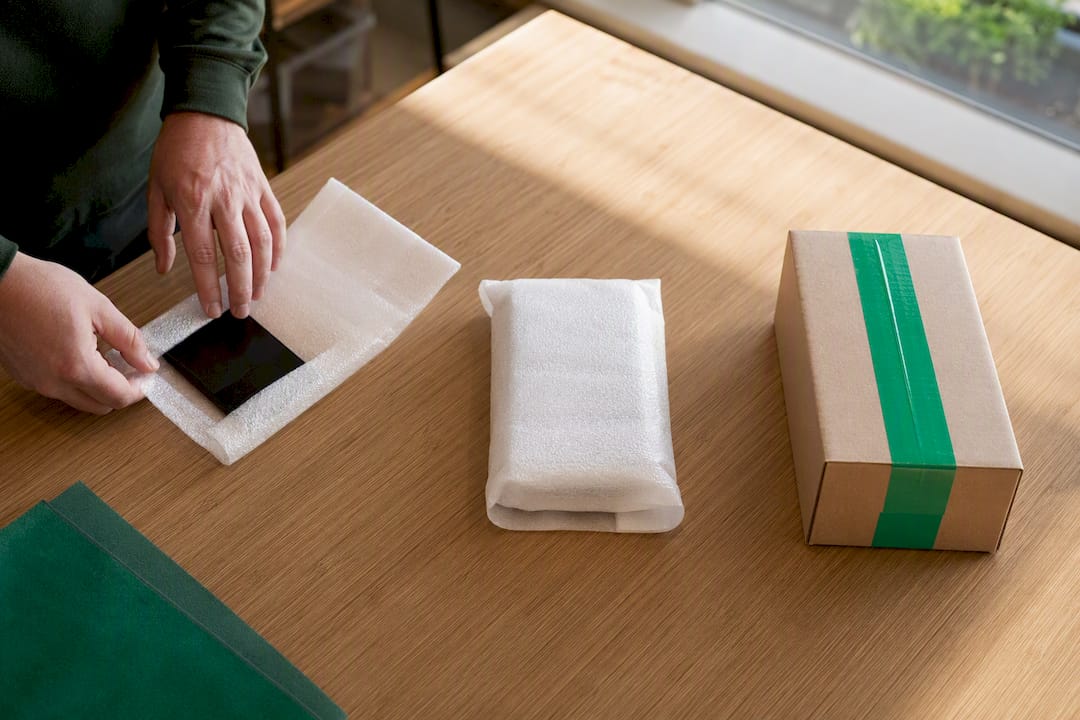
If you still have the original manufacturer box, use it. It’s engineered around that exact phone’s dimensions and weight, which beats almost any generic mailer you’ll find at a shipping counter.
What Are the Lithium Battery Rules for Shipping a Phone?
Every smartphone battery is classified as a hazardous material by PHMSA and the DOT, which sounds alarming until you realize the rules are mostly about labeling and packaging integrity, not paperwork you need a lawyer for.
Batteries installed in a working phone (UN3481) face far fewer restrictions than loose spare batteries (UN3480) shipped on their own. If your battery is installed and functioning normally, you’re in the simpler category. Packaging must be built to survive a 1.2 meter drop test without short-circuiting, which is one more reason the 2-inch cushioning rule isn’t optional padding advice, it’s a compliance buffer.
Key points to check before you tape the box shut:
- Mailpieces with lithium batteries need a rigid, sealed outer container and the DOT-approved lithium battery mark visible on the address side, per USPS packaging rules.
- Used or defective devices may require “Restricted Electronic Device” or “Surface Mail Only” text on the label.
- HM-215Q updates, effective May 10, 2024, revised watt-hour marking requirements and are phasing out the mandatory telephone number on labels by December 31, 2026.
- Damaged, swollen, or recalled batteries cannot legally travel by air under any circumstance and require special ground handling.
The phaseout date on that phone number requirement is a small detail most shippers miss, but it shows how often these rules get updated. What was correct labeling two years ago might not be correct today, so a quick check of current carrier guidance before shipping a batch of devices is worth the five minutes.
Should You Ship Ground or Air, and Do You Need Insurance?
Ground shipping is the default answer for phones, and not just because it’s cheaper. Air transport carries tighter restrictions on lithium batteries, so ground avoids compliance friction on top of saving money.
For a single phone under 5 pounds, USPS Ground Advantage is typically the most cost-effective option and sidesteps many of the air-specific battery rules altogether. FedEx and UPS ground services work similarly well; their express air options exist, but they come with the same battery scrutiny air always brings, plus a higher price tag for something a phone rarely needs urgently.
On insurance and signatures, match the coverage to the value:
- Ground service (USPS Ground Advantage, UPS Ground, FedEx Ground) covers nearly all single-phone shipments.
- Reserve express or air only for time-sensitive business shipments where the battery is installed and undamaged.
- Require a signature on anything valued over roughly a competitive amount to cut porch-theft risk.
- For devices worth more than a solid amount third-party shipping insurance is often more cost-effective than a carrier’s declared-value coverage.
How Do You Ship Damaged Batteries or Bulk Device Shipments?
Damaged, swollen, or recalled batteries change the rules entirely. They generally cannot travel by air at all and need specialized packaging designed to prevent short-circuiting and thermal propagation, including non-metallic inner packaging and physical separation from other batteries, per federal transport rules.
If you’re shipping more than a handful of devices at once, treat it as a different job entirely:
- Bulk consignments often require formal manifesting and stricter UN marking than a single-item shipment.
- Damaged batteries need highway, rail, or vessel transport, never air, and sometimes require emergency response documentation.
- For large volumes or anything regulated, a professional ITAD program or a bulk device buyback service removes the compliance guesswork entirely.
If you’re not sure which category your device falls into, that uncertainty alone is a signal to route it through a program built to handle exactly this.
What Should You Do If Your Phone Is Lost or Damaged in Transit?
Recovering money on a damaged or lost phone comes down to what you documented before you sealed the box. Move fast, since most carriers have filing windows measured in days, not weeks.
- Photograph the bare device, the packed box, and the sealed outer box before drop-off, along with the receipt showing value and the IMEI or serial number.
- Decide on coverage in advance, third-party insurance usually beats carrier-declared value once a device is worth more than a solid amount.
- If damage or loss occurs, contact the carrier immediately, submit your photos and proof of value together, and follow up in writing if you don’t hear back within a few business days.
Why Sellers Overestimate the Risk of Shipping a Phone
Most guides make shipping a phone sound riskier than it actually is, mostly because they lump every worst-case scenario together. A phone with an installed, undamaged battery shipped ground in a well-cushioned box is genuinely low-risk. The real danger zone is narrower than people assume: swollen or damaged batteries, bulk shipments without proper manifesting, and skipping the data wipe entirely.
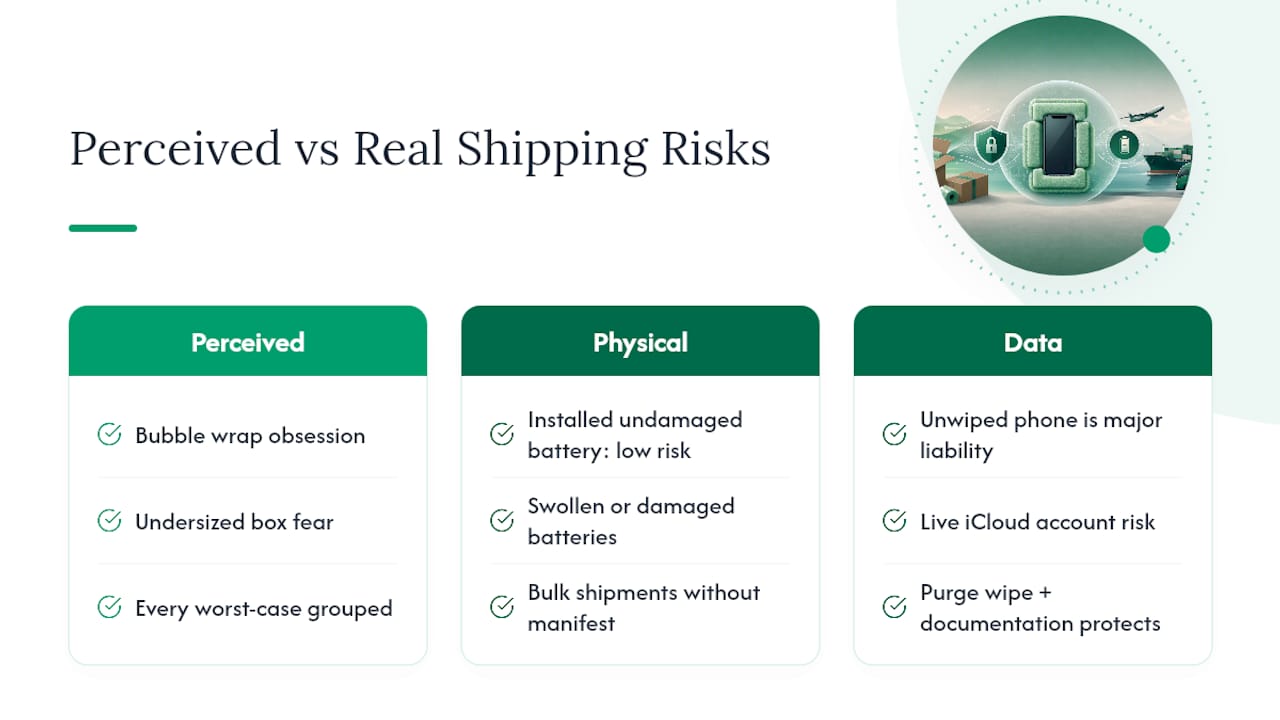
What gets underrated is the data side, not the physical side. People obsess over bubble wrap and forget that an unwiped phone tied to a live iCloud account is a bigger liability than a slightly undersized box. A purge-level wipe with documentation protects you legally and financially in ways that packing tape never will.
If there’s one habit worth adopting from professional reverse logistics operations, it’s treating documentation as part of the shipment, not an afterthought. Photos of the device, the wipe confirmation, the sealed box. That paper trail is what turns a shipping mistake into a quick fix instead of a dispute.
, Andy
Skip the Packing Tape: Ship Your Phone Free With BuyBackBear
BuyBackBear removes the two hardest parts of shipping a phone yourself: the data wipe and the packaging risk. Once you get an instant quote, we send a free prepaid label, so there’s no guessing on carrier selection, battery labeling, or cushioning specs. You pack it once, following our simple guidelines, and we handle the rest.
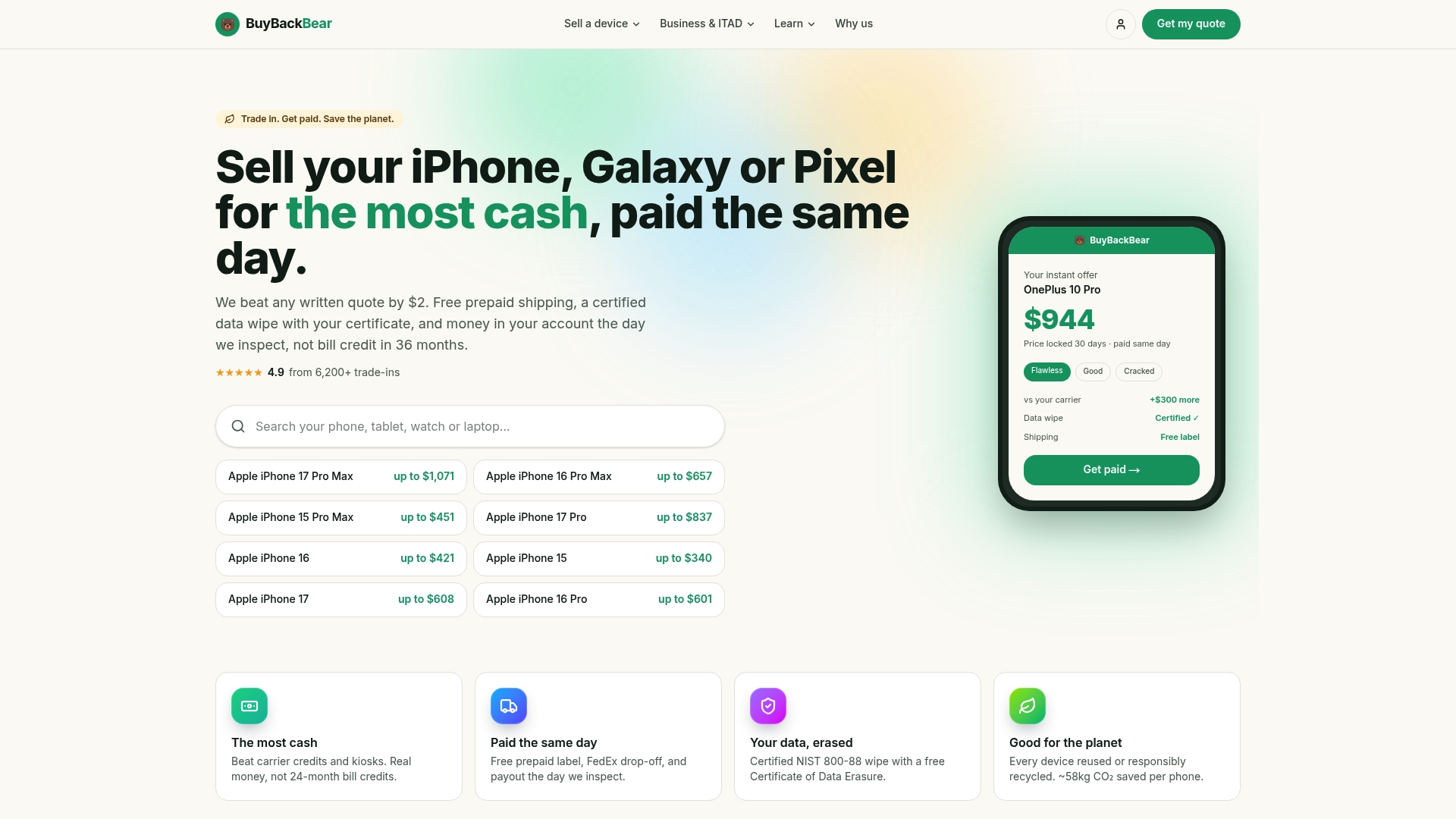
Every device that comes through our doors gets a certified NIST 800-88 wipe with a free certificate of data erasure, so there’s paperwork behind the privacy claim, not just a promise. We also track competitor buyback prices daily and beat any written quote by a competitive amount and anything that can’t be resold gets recycled responsibly instead of landfilled. The process runs in four steps: get your instant quote, ship free with the prepaid label, we inspect and confirm the offer, and you get paid the same day, by PayPal, Venmo, debit card, or bank transfer.
Ready to stop worrying about lithium battery labels and drop-test packaging? Get your instant quote and start your phone trade-in today.
Where to Verify Current Shipping Rules
Carrier and federal rules change, so confirm details before you ship: PHMSA lithium battery guidance, NIST SP 800-88 media sanitization standard, and USPS mailing standards for batteries. Always check your specific carrier’s current page for service-level exceptions.
Sources
- NIST SP 800-88 Revision 2
- PHMSA. Lithium batteries and cells
- USPS Packaging Instruction 9D / Pub 52 excerpt
FAQ
What is the safest way to ship a phone?
Wipe the device using purge-level sanitization, remove the SIM and eSIM, then double-box it with at least 2 inches of cushioning on every side and ship it ground with the correct lithium battery markings.
What is the cheapest way to ship a cell phone?
For a single phone under 5 pounds, USPS Ground Advantage is typically the most cost-effective option, and it also avoids many of the stricter battery rules that apply to air shipping.
Is it cheaper to ship a phone through UPS or USPS?
USPS Ground Advantage usually beats UPS and FedEx ground rates for a single small, lightweight phone shipment, though bulk or business shipments can shift that math depending on volume discounts.
What is the best way to send a phone if I want it insured?
Require signature confirmation for shipments over roughly a competitive amount and for devices worth more than a solid amount third-party insurance tends to be more cost-effective than a carrier’s declared-value coverage.
Can I ship a phone with a damaged or swollen battery?
No, damaged or swollen lithium batteries generally cannot travel by air and require specialized ground or rail transport with packaging built to prevent short-circuiting, following federal hazardous materials rules.
Recommended
Ready to sell?
Get an instant quote, free prepaid shipping, and fast cash that beats carrier trade-in credit.
Selling your device here, at a glance
Get my instant quote →- Instant quote in about 30 seconds, price locked while you decide
- Cash by PayPal, Zelle, Venmo or check after inspection, no fees
- Free prepaid label both ways, free return shipping if you decline
- We beat any competitor's written quote by $2
- Cracked screen, broken or won't power on? Still worth real money
- Certified NIST 800-88 data wipe with an emailed certificate
- Trade-in value paid in cash, not a 24-36 month carrier bill credit
- Every model priced: unlocked or carrier-locked, any storage size