What Is a Water-Damaged Phone Worth? Sell It for Cash
August 15, 2026
Yes, you can sell a water-damaged phone, and in most cases you should sell it as-is rather than paying for repairs first. The fastest, most straightforward route is an online buyback service. Buybackbear accepts liquid-damaged devices, ships you a free prepaid label, and pays via PayPal, Venmo, debit card, or bank transfer the same day it inspects your device.
A few things to know before you ship anything:
- Liquid Contact Indicators (LCIs): Tiny sensors inside your phone turn red or pink on contact with water. Apple documents these sensors and confirms that liquid damage voids standard warranty coverage, so don’t expect a free repair from the manufacturer.
- Power-on status: A phone that still turns on is worth meaningfully more than one that won’t. Buyers use this as the first triage check.
- Visible corrosion: Green or white residue on charging ports, SIM trays, or internal connectors signals board-level damage and lowers offers significantly.
Knowing these three signals helps you set realistic expectations before you get your first quote.
Key Takeaways
Water-damaged phones still have real resale value, and selling as-is to an online buyback service is almost always faster and financially smarter than paying for repairs first.
| Point | Details |
|---|---|
| Sell as-is, skip the repair | Repair costs for water damage often equal or exceed the resale uplift, making selling as-is generally the better financial choice. |
| Expect a fraction of the working value, depending on condition. | Payout depends on whether the phone powers on, which components work, and corrosion severity. |
| Get multiple quotes first | Collect 3–5 live quotes using “faulty” or “liquid damaged” condition filters before committing to a buyer. |
| Request a NIST 800-88 certificate | Ask your buyer for a Certificate of Data Erasure to confirm personal data was wiped to federal standards. |
| Buybackbear accepts liquid damage | Buybackbear buys water-damaged phones, ships free, pays same-day, and provides a certified data wipe. |
Table of Contents
- Where can you sell a water-damaged phone?
- How do buyers assess water damage?
- Should you repair the phone before selling?
- How to get accurate quotes and compare offers
- How to prepare your water-damaged phone before shipping
- What to expect during inspection, timelines, and payment
- How much is a water-damaged phone worth?
- What’s the recommended route for selling a water-damaged phone?
- Why buyback services make the most sense for damaged phones
- Cash for your water-damaged phone, handled properly
- Sources
- FAQ
Where can you sell a water-damaged phone?
Several routes exist, and they differ sharply on payout speed, effort, and how tolerant they are of liquid damage.
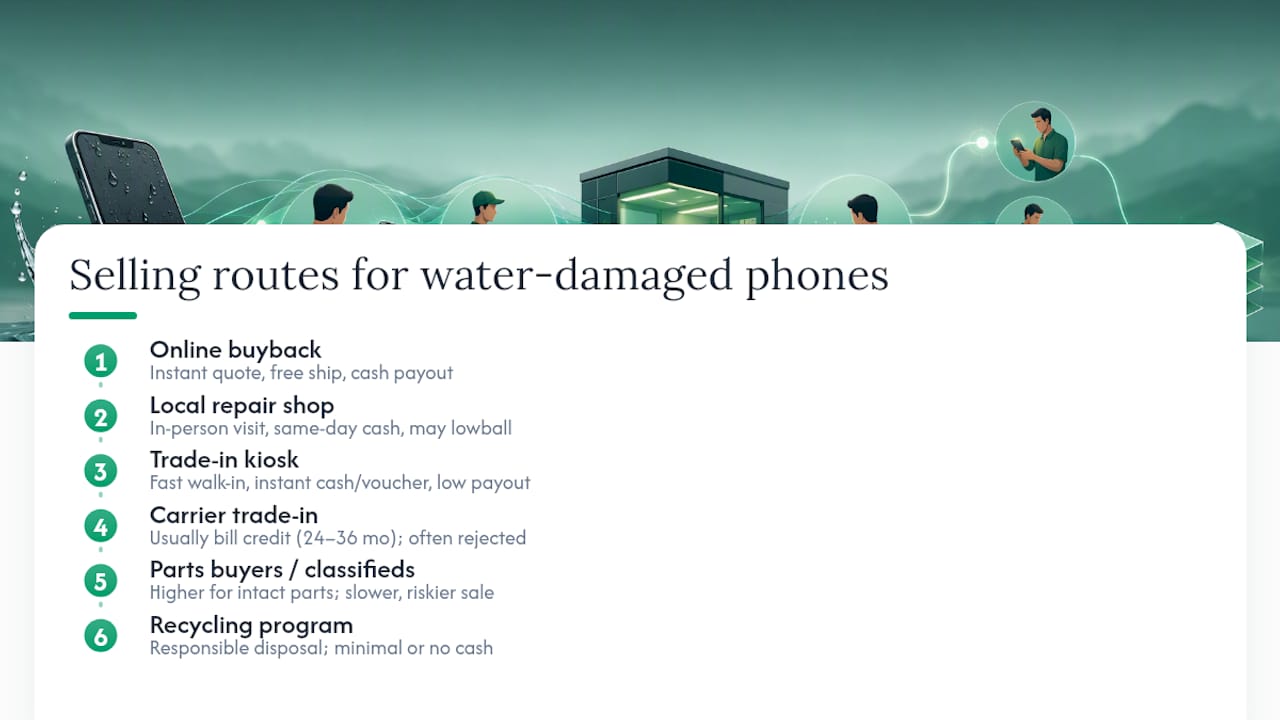
Online buyback services are the most practical option for most sellers. You get an instant quote online, select “faulty” or “liquid damaged” as the condition, ship for free, and receive cash. These services have refurbishment networks that can extract value from partially working devices, which is why they pay more than recyclers for phones that still power on.
Local repair and resale shops sometimes buy water-damaged phones for parts or refurbishment. Prices vary widely, and you’ll need to visit in person. The upside is same-day cash; the downside is that small shops often lowball because they’re absorbing all the repair risk themselves.
Trade-in kiosks like ecoATM accept broken and dead phones at physical locations, typically in grocery stores and malls. The process is fast, but payouts for liquid-damaged devices tend to sit at the lower end of the range since kiosks apply conservative automated pricing.
Carrier trade-ins are generally a poor fit for water-damaged phones. Most carriers either reject liquid-damaged devices outright or offer minimal bill credit, and that credit is spread over 24–36 months rather than paid as cash.
Parts buyers and classifieds (Facebook Marketplace, eBay “for parts”) can occasionally yield strong prices for popular models with intact screens or working cameras, but the process is slower, riskier, and requires more effort to photograph, list, and ship safely.
Recycling programs pay little or nothing but handle disposal responsibly. Worth considering only if the device is completely dead and has no resale value.
| Online buyback service | Quick cash, convenience | Multiple methods; free prepaid label | Moderate to high | varies depending on condition. | Local repair/resale shop | Same-day cash | Cash in person | Moderate | varies | | Trade-in kiosk | Walk-in convenience | Cash or voucher on the spot | Low to moderate | varies | | Carrier trade-in | Upgrading to a new phone | Bill credit over 24–36 months | Low; often rejected | varies (credit only) | | Parts buyer / classifieds | High-demand model with working parts | Varies; buyer arranges shipping | High for parts | varies | | Recycling program | Responsible disposal | Minimal cash or free | High (accepts all) | varies |
How do buyers assess water damage?
Every buyer, from a kiosk algorithm to a human refurbisher, runs through a similar checklist. Understanding it helps you document your device accurately and avoid a surprise price adjustment after shipping.
Liquid Contact Indicators are the first stop. Wikipedia’s overview of LCIs explains that manufacturers place these sensors at key internal points. A triggered LCI tells the buyer liquid reached the internals, even if the phone looks fine externally. You can’t reset an LCI, so there’s no point trying to hide it.
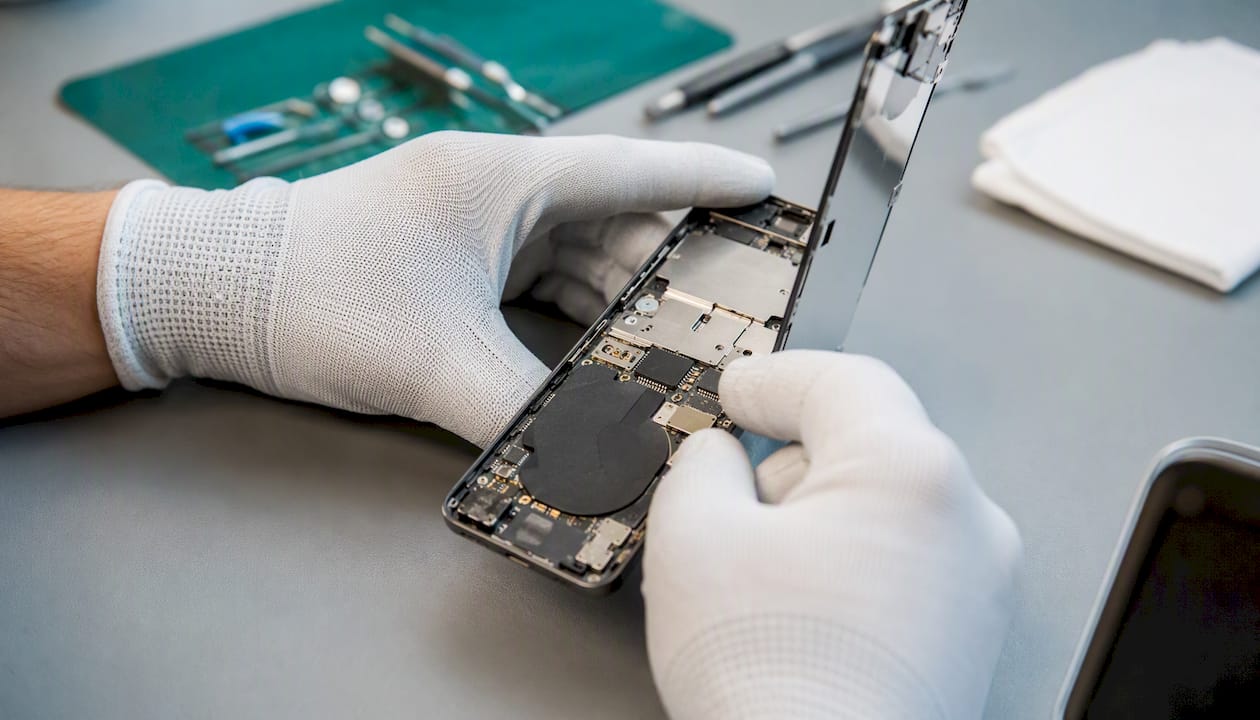
Power-on test is the single biggest value driver after the LCI. A phone that boots, even with a cracked screen or a glitchy camera, is worth far more than one that’s completely dead. Buyers can test components on a live device; a dead one is parts-only.
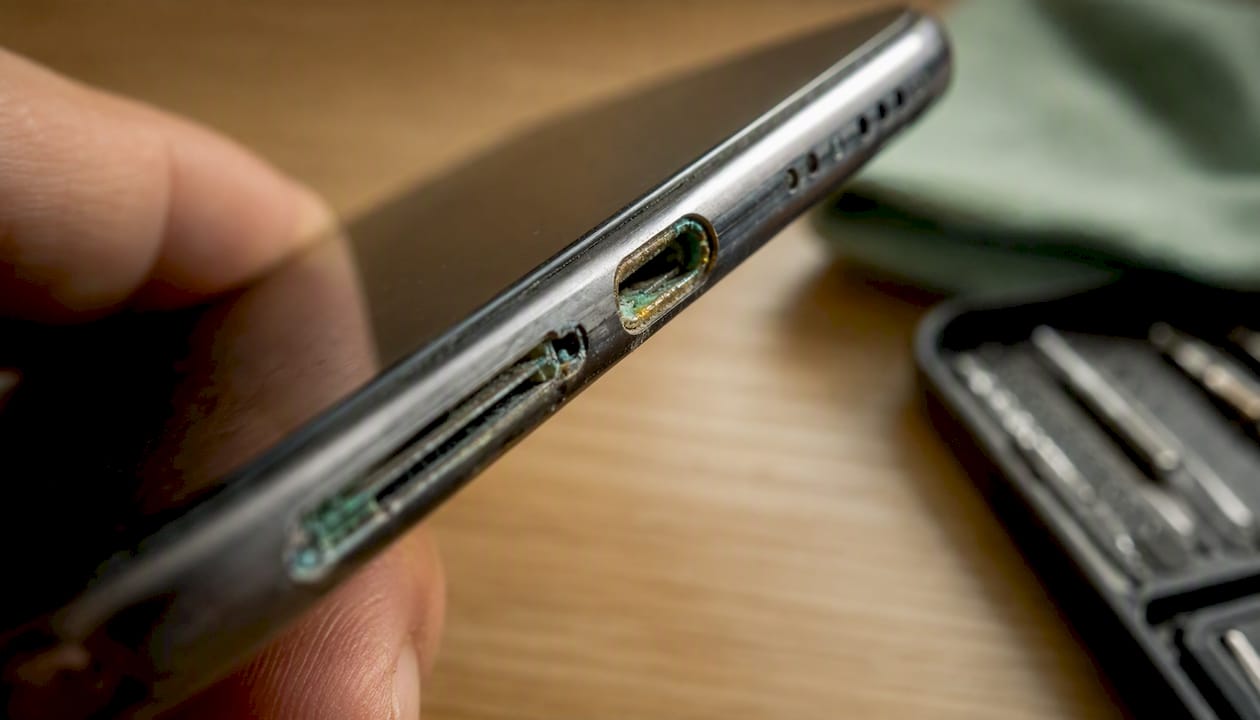
Corrosion on connectors and the logic board is what actually kills phones over time. Salt water and mineral-heavy tap water accelerate corrosion faster than clean water. Buyers look for green or white deposits on the charging port, SIM tray, and any exposed board contacts. Corrosion that has spread to the logic board typically pushes a device into the recycling category.
Display and touch function matter because screens are expensive to replace. A phone with a fully working display commands a noticeably higher offer than one with dead pixels, touch dropout, or a cracked panel on top of water damage.
Battery behavior is checked because water damage often degrades battery health quickly. Swollen batteries are a safety concern and will trigger rejection or a sharply reduced offer.
Camera, Face ID, and fingerprint sensor failures are common after liquid exposure. Buyers test each one. A broken Face ID module on an iPhone, for example, is expensive to repair and reduces the offer accordingly.
Odor and contamination from salt water, pool chemicals, or other liquids signal more aggressive corrosion risk. Buyers factor this in even when the board looks clean.
Pro Tip: Before shipping, photograph the charging port, SIM tray slot, and any visible corrosion with a flashlight and macro mode on another phone. Document every symptom: what works, what doesn’t, and when the damage occurred. Buyers who receive accurate descriptions are less likely to adjust the offer after inspection.
Should you repair the phone before selling?
The short answer: usually no. Here’s a simple framework to decide.
Step 1: Get a repair estimate. Contact an Apple Authorized Service Provider or a reputable third-party shop. Apple’s repair page lists out-of-warranty service paths and gives a baseline for official repair costs, which often run a solid amount depending on the model and what’s damaged.
Step 2: Get a quote for the phone as-is. Use a buyback service to get a live offer for the liquid-damaged condition right now.
Step 3: Get a quote for the phone in working condition. Check what the same model in good working condition fetches. The difference between the two quotes is your maximum possible uplift from repairing.
Step 4: Compare repair cost to uplift.
- If repair cost is less than the uplift and the repair has a reasonable success rate, repairing first can make financial sense.
- If repair cost equals or exceeds the uplift, sell as-is.
- If the repair outcome is uncertain, sell as-is.
Water damage repairs carry a reliability problem that most other phone repairs don’t. iFixit’s community guidance notes that even resealing a “waterproof” phone at home rarely restores factory-level ingress protection. Professional water damage repair often involves ultrasonic cleaning and component replacement, and there’s no guarantee the phone won’t develop new faults weeks later from corrosion that wasn’t visible during repair.
A quick example: Suppose your water-damaged iPhone 13 fetches a competitive offer as-is. The same model in working condition sells for a competitive offer. The uplift ceiling is a competitive amount. If a shop quotes a competitive amount to repair it with no warranty on the water damage work, the math doesn’t work. Sell as-is for a competitive amount and move on.
The rule of thumb: if repair cost is greater than or equal to the expected uplift, or if the repair shop can’t guarantee the outcome, selling as-is is the faster and financially safer choice.
Also worth noting: Apple’s warranty document explicitly excludes liquid damage from standard coverage, so you’re paying out of pocket regardless of how new the device is.
How to get accurate quotes and compare offers
Getting three to five quotes takes about 20 minutes and can meaningfully change what you walk away with.
- Select the right condition category. On buyback sites, choose “faulty,” “broken,” or “liquid damaged” rather than a working condition tier. Selecting a higher condition to get a better quote will result in an adjusted (lower) offer after inspection, which wastes everyone’s time.
- Collect quotes from multiple sources. Run the same model and condition through several buyback services. Use Buybackbear’s trade-in tools and calculators to compare offers side by side.
- Disclose symptoms in detail. Note what works and what doesn’t: powers on, screen functional, camera broken, charging port corroded. Accurate disclosure reduces the chance of a post-inspection price revision.
- Attach photos. Clear photos of the charging port, LCI area, and any visible corrosion help buyers confirm your description before they commit to a price.
- Check payment and shipping terms. Confirm the service offers a free prepaid shipping label. Confirm payout methods (PayPal, Venmo, bank transfer, check) and how quickly payment is issued after inspection.
- Ask about the inspection hold policy. Some services hold payment for 3–5 business days after inspection; others pay the same day. Know this before you ship.
- Ask about adjusted-offer policy. If the buyer finds additional damage, will they give you the option to accept the new price or get the device back? Services that offer a return option give you more control.
Pro Tip: Lock in your quote before shipping wherever the service allows it. Prefer services that provide a free prepaid label and a NIST 800-88 data wipe with a Certificate of Data Erasure. The certificate is proof your personal data was destroyed, not just deleted.
How to prepare your water-damaged phone before shipping
A little preparation reduces friction at inspection and protects your data.
- Back up your data first if the phone still powers on. Use iCloud, Google One, or a direct computer backup. Once the phone ships, you won’t get another chance.
- Remove your Apple ID and disable Find My (or the Android equivalent, Google account removal). A phone with an active activation lock is worth significantly less, and some buyers won’t accept it at all.
- Erase the device if it powers on. Go to Settings and perform a factory reset. If it won’t power on, the buyer’s NIST 800-88 wipe handles data destruction.
- Note the IMEI and serial number. Find these on the original box, in Settings, or by dialing *#06#. You’ll need them for the quote and for your own records.
- Photograph the damage and the model/IMEI sticker before packing. This protects you if there’s a dispute about the device’s condition on arrival.
- Do not try to charge a wet phone. Consumer Reports advises against home remedies and recommends professional assessment. Charging a phone that still has moisture inside can short the board and turn a partially working device into a dead one.
- Allow the phone to air-dry before packing, but skip the rice bowl. The Guardian’s myth-busting piece explains that rice doesn’t draw moisture from electronics effectively and can introduce dust and starch into ports.
- Pack with cushioning. Wrap the phone in bubble wrap, tape any loose parts (cracked back glass, detached SIM tray), and use a sturdy box. Damage in transit can void the offer.
- Request a NIST 800-88 Certificate of Data Erasure from the buyer. Reputable buyback services provide this automatically; it’s your proof that personal data was wiped to federal standards.
Use Buybackbear’s pre-shipping checklist to confirm you haven’t missed a step before you drop the package off.
What to expect during inspection, timelines, and payment
Once your phone arrives at the buyer, the process typically runs like this:
- Arrival and intake: The buyer logs your device and matches it to your quote by IMEI or serial number.
- Inspection window: Most buyback services complete inspection within 24–72 hours of receiving the device. High-volume periods or complex damage can push this to 5–7 business days.
- Offer confirmation or adjustment: If the device matches your description, the original offer is confirmed. If the buyer finds additional damage (hidden corrosion, a failed component you didn’t mention, or a triggered LCI you didn’t disclose), they’ll issue a revised, lower offer.
- Your options on an adjusted offer: Accept the new price and receive payment, or request the device back. Not all services offer a free return, so confirm this policy before shipping.
- Payment: Common payout methods include PayPal, Venmo, bank transfer, debit card, and check. Some services, including Buybackbear, offer same-day payment after inspection is complete.
- After payment: The buyer wipes the device to NIST 800-88 standard, issues a Certificate of Data Erasure, and either refurbishes the phone for resale or routes it to responsible recycling if it’s beyond repair.
The most common triggers for a lowered offer are: corrosion that wasn’t visible in photos, a component failure the seller didn’t notice (Face ID, Touch ID, cellular modem), and an activation lock that wasn’t removed before shipping.
How much is a water-damaged phone worth?
The honest answer is: it depends on several variables, and live quotes are the only reliable way to know your specific number. That said, a realistic framework helps you set expectations.
The main variables that move price:
- Model and market demand. A current-generation iPhone or Samsung Galaxy flagship holds more parts value than a three-year-old mid-range device.
- Ability to power on. This is the single biggest binary. A phone that boots commands a meaningfully higher offer than one that’s completely dead.
- Which components work. Screen, battery, cameras, Face ID/Touch ID, and cellular modem each carry their own repair cost. More working components mean a higher offer.
- Severity and location of corrosion. Port-level corrosion is manageable; logic board corrosion is often fatal to resale value.
- Carrier lock status. An unlocked phone sells for more. A carrier-locked phone limits the buyer’s resale market.
- Cosmetic condition. Cracked glass on top of water damage compounds the discount.
Rough price expectations as a percentage of working value:
To put dollar figures on this: a recent flagship iPhone in good working condition might trade in for a solid amount. Water-damaged but powering on, expect a solid amount. Dead, expect a solid amount. Mid-range Android models follow a similar proportional pattern at lower absolute values. These are illustrative ranges, not quotes. Get live offers for your exact model and condition.
Buybackbear’s trade-in value research shows how much trade-in prices vary across channels, which is exactly why collecting multiple quotes matters before you commit to a buyer.
What’s the recommended route for selling a water-damaged phone?
Sell as-is to a reputable online buyback service. It’s the fastest path to cash, requires the least effort, and avoids the financial risk of paying for repairs that may not hold.
Three actions to take right now:
- Get quotes. Visit Buybackbear and at least one other buyback service. Select “faulty” or “liquid damaged.” Collect offers within 20 minutes.
- Prepare the device. Back up data, remove your Apple ID or Google account, disable Find My, erase if possible, note the IMEI, and photograph the damage.
- Ship with the prepaid label. Pack carefully, drop it off, and await inspection. Expect payment within 24–72 hours of the buyer receiving the device.
After acceptance, the buyer wipes your data to NIST 800-88 standard, issues a Certificate of Data Erasure, and either refurbishes the phone or recycles it responsibly. You get cash. The device doesn’t end up in a landfill.
Why buyback services make the most sense for damaged phones
Most sellers instinctively reach for a repair shop first, and I understand why. It feels like you’re maximizing value. But the economics of water damage repair almost never support that instinct.
Repair shops price water damage work to cover their own uncertainty. They’re absorbing the risk that the board fails three weeks after they hand it back, and their quotes reflect that. You’re essentially paying a premium for a gamble. Buyback services, by contrast, have refurbishment networks that can spread repair costs across hundreds of devices, extract parts value from phones that can’t be fully restored, and route the rest to certified recycling. They can afford to pay you more than a local shop because they’re operating at scale.
The data-wiping piece matters more than most sellers realize. A factory reset doesn’t erase data to a forensic standard. NIST 800-88 compliant wiping does, and a Certificate of Data Erasure gives you documented proof. For anyone who’s used their phone for banking, health apps, or work email, that certificate is worth requesting explicitly.
Speed is the other underrated factor. Every week a water-damaged phone sits in a drawer, corrosion spreads. A phone worth a good amount today might be worth a good amount in two months. Selling quickly isn’t just convenient; it’s financially rational.
Cash for your water-damaged phone, handled properly
Buybackbear accepts liquid-damaged iPhones, Samsung Galaxy phones, Google Pixels, and other devices whether they power on or not. Free prepaid shipping means you pay nothing to send it. Inspection typically completes within 24–72 hours of arrival, and payment goes out the same day via PayPal, Venmo, debit card, or bank transfer. No bill credit, no waiting months.
Every device Buybackbear processes gets a NIST 800-88 compliant data wipe with a Certificate of Data Erasure included at no charge. Phones that can be refurbished go back into circulation; those that can’t are recycled responsibly. Buybackbear also tracks competitor buyback prices daily and beats any written quote by a competitive amount so you’re not leaving money on the table by skipping the comparison shopping.
To get started, visit the phones sell page, select your model, choose “faulty” or “liquid damaged” as the condition, and get an instant quote. Pack per the checklist above, ship with the prepaid label, and you’re done.
Sources
FAQ
Can you sell a water-damaged phone?
Yes. Water-damaged phones have resale value as long as buyers can extract parts or refurbish them. Online buyback services, local repair shops, and trade-in kiosks all accept liquid-damaged devices, though payouts vary by condition.
How much is a water-damaged iPhone worth?
A water-damaged iPhone that still powers on typically fetches substantially less than a fully functional device. One that’s completely dead is valued primarily for parts and resale is much lower. Get a live quote for your exact model and condition for an accurate figure.
Is it worth fixing a phone with water damage before selling?
Rarely. Repair costs for water damage often equal or exceed the resale uplift, and iFixit notes that repairs don’t reliably restore factory waterproofing. Sell as-is unless the repair cost is clearly less than the price difference between damaged and working condition.
Who buys water-damaged phones in the U.S.?
Online buyback services like Buybackbear, trade-in kiosks like ecoATM, local repair shops, and parts buyers on classifieds platforms all purchase liquid-damaged phones. Buybackbear accepts cracked, dead, and liquid-damaged devices with free prepaid shipping and same-day payment.
Does water damage void the phone’s warranty?
Yes. Apple’s warranty document explicitly excludes liquid damage from standard coverage, and Apple uses Liquid Contact Indicators to confirm exposure during any service request. Most other manufacturers have similar exclusions.
Recommended
Ready to sell?
Get an instant quote, free prepaid shipping, and fast cash that beats carrier trade-in credit.
Selling your device here, at a glance
Get my instant quote →- Instant quote in about 30 seconds, price locked while you decide
- Cash by PayPal, Zelle, Venmo or check after inspection, no fees
- Free prepaid label both ways, free return shipping if you decline
- We beat any competitor's written quote by $2
- Cracked screen, broken or won't power on? Still worth real money
- Certified NIST 800-88 data wipe with an emailed certificate
- Trade-in value paid in cash, not a 24-36 month carrier bill credit
- Every model priced: unlocked or carrier-locked, any storage size